


(Anomalepididae)
Dawn Blind Snakes
Американські сліпуни
The Anomalepididae are a family of nonvenomous snakes, native to Central and South America. They are similar to Typhlopidae, except that some species possess a single tooth in the lower jaw. Currently, four genera and 20 species are recognized. Common names include primitive blind snake and dawn blind snake.
The family Anomalepididae is found from Southern Central America to north-western South America. Disjunct populations occur in north-eastern and south-eastern South America. These snakes are fascinating due to their specialized adaptations for a burrowing lifestyle, which makes them appear significantly different from more familiar snakes.
Anomalepididae snakes are small and slender, with smooth, glossy skin covered in scales that help facilitate their movement through soil and leaf litter, environments where they spend the majority of their lives. One of the most notable features of these snakes is their head, which is equipped with a blunt shape perfect for burrowing. This feature, combined with their reduced eyes that are covered by translucent scales, gives them a distinct “blind” appearance. Although they are not completely sightless, they have very limited vision and are primarily sensitive to light changes.
In terms of diet, these snakes primarily feed on small invertebrates such as ants, termites, and small worms. They are adapted to detect their prey through chemical cues in the soil, utilizing their highly sensitive tongue and Jacobson’s organ, a sensory structure that enhances their ability to “taste” the air or soil to locate food sources.
An interesting aspect of Anomalepididae snakes is their reproductive strategy. They are oviparous, laying eggs rather than giving birth to live young. The females carefully select moist and secure locations in the soil to deposit their eggs, ensuring the best possible start for their offspring. The eggs are relatively small, and the young snakes are independent from birth, equipped with all the necessary adaptations to survive in their underground habitats.
Despite their secretive nature, these snakes exhibit a fascinating behavior known as “concertina movement,” which involves anchoring part of their body while stretching forward and then pulling the rest of the body along. This method of movement is highly efficient for navigating through tight spaces in the soil and leaf litter.
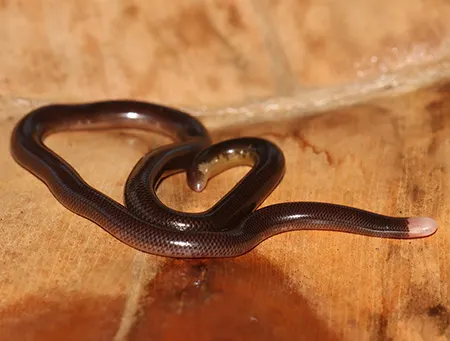
(Typhlophis squamosus)
Trinidad Blind Snake
It is found in the Atlantic coastal lowlands of South America in Guyana, Suriname and French Guiana as far south as the state of Pará in Brazil. It is also found on the island of Trinidad. It lives in humid tropical forests at elevations of 50–600 m.
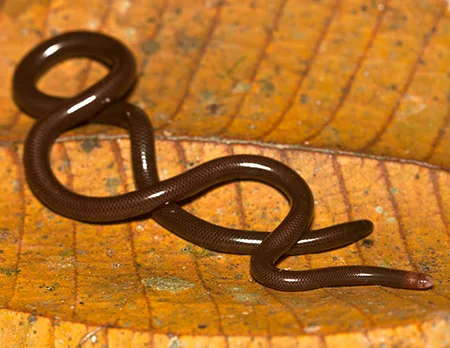
(Liotyphlops albirostris)
Whitenose Blind Snake
Сліпун біломордий
It is found on the Pacific slopes from southern Costa Rica through Panama to Colombia and Venezuela. It inhabits humid and dry tropical forests, as well as rice fields, pastures, and areas near human settlements.
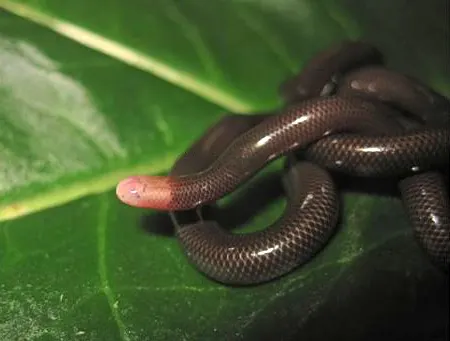
(Liotyphlops anops)
Cope's Blind Snake
Сліпун Коупа
It is known from two localities in Colombia: one near Bogotá in the department of Cundinamarca, and the other near Villavicencio in the department of Santander. It inhabits humid lowland tropical forests.
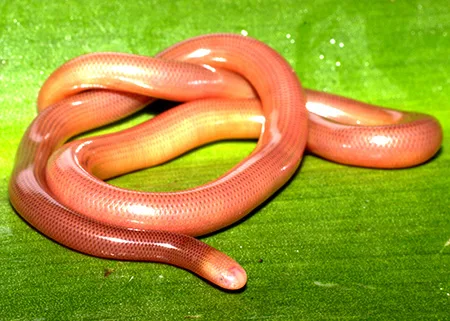
(Liotyphlops argaleus)
Cundinamarca Blind Snake
Сліпун кундінамаркський
It is known from several localities in the Colombian department of Cundinamarca.
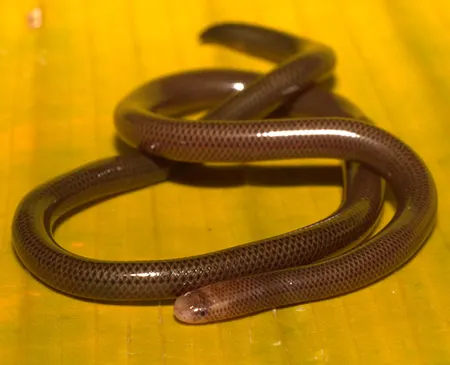
(Liotyphlops bondensis)
Bonda Blind Snake
It is found on the Caribbean coast of Colombia, and possibly also in western Venezuela.
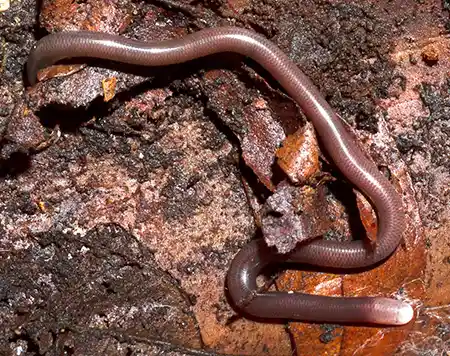
(Liotyphlops caissara)
São Sebastião Blind Snake
It is known from two specimens collected on Anchieta and Ilhabela islands off the coast of São Paulo state, Brazil. It inhabits dense, humid Atlantic forests.
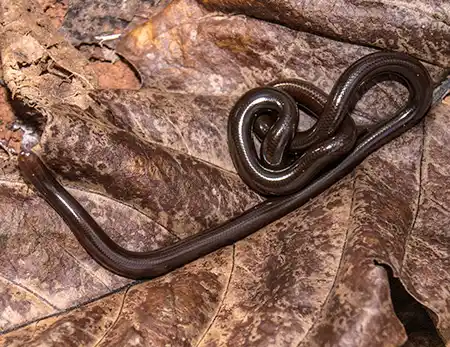
(Liotyphlops taylori)
Mato Grosso Blind Snake
Сліпун Тейлора
It is known only from the type specimen collected at the Serra das Araras Ecological Station in the municipality of Porto Estrela, Mato Grosso, Brazil, where it inhabits cerrado savannas.
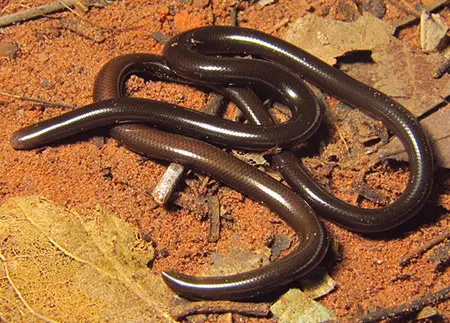
(Liotyphlops ternetzii)
Ternetz's Blind Snake
Сліпун Тернеца
It is found in northern Argentina, Paraguay, Uruguay, and Brazil. The natural habitats are grassland, savanna, and gallery forest, at altitudes of 200–1,000 m.
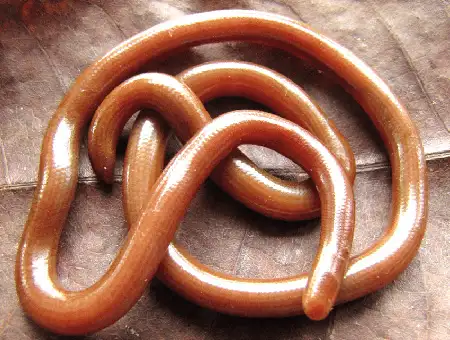
(Liotyphlops trefauti)
Alagoas Blind Snake
Сліпун алагоаський
It is found in the Brazilian states of Alagoas, Bahia, and Pernambuco in north-eastern Brazil, where it inhabits humid Atlantic forests.
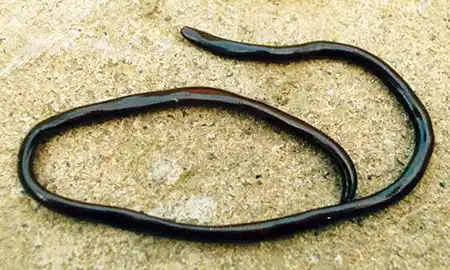
(Liotyphlops wilderi)
Wilder's Blind Snake
Сліпун Вайлдера
It is found in south-eastern Brazil, in the Brazilian states of Minas Gerais and Rio de Janeiro. It inhabits humid Atlantic forests, seasonally humid forests, and cerrado savannas.
The genus (Liotyphlops) also includes: Southern Colombian Blind Snake (Liotyphlops haadi), São Paulo Blind Snake (Liotyphlops schubarti), (Liotyphlops palauophis).
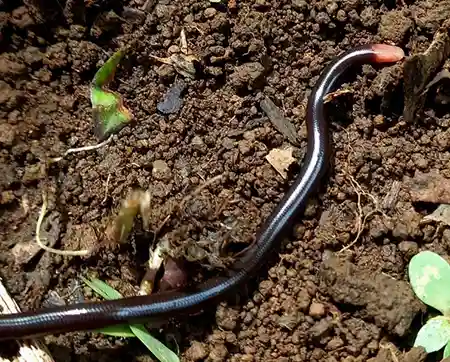
(Helminthophis frontalis)
Costa Rica Blind Snake
Сліпун червоподібний коста-риканський
It is known from several localities in Costa Rica and Panama, where it inhabits humid tropical forests, coffee plantations, and orchards at altitudes of 96–1,435 m.
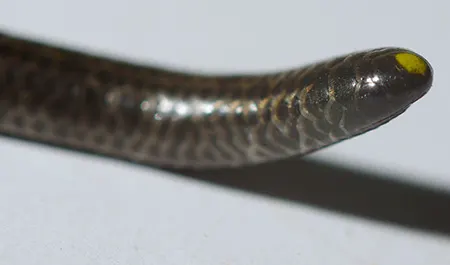
(Helminthophis praeocularis)
Preocular Blind Snake
It is found in the Colombian departments of Cundinamarca, Tolima, Santander, and Norte de Santander, where it inhabits humid tropical Andean forests at altitudes of 200–1,746 m.
The genus (Helminthophis) also includes: Yellowtail Blind Snake (Helminthophis flavoterminatus).
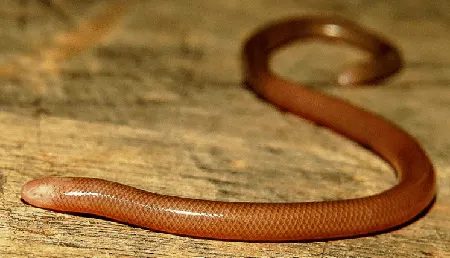
(Anomalepis mexicana)
Mexican Blind Snake
Сліпун мексиканський
It is found in Nicaragua, Costa Rica, Panama, and possibly Peru. It inhabits humid tropical forests on the plains and in the foothills, at altitudes of up to 500 m.
The genus (Anomalepis) also includes: Taylor’s Peru Blind Snake (Anomalepis aspinosus), Colombian Blind Snake (Anomalepis colombia), Ecuador Blind Snake (Anomalepis flavapices).
