


(Callorhinchidae)
Plownose Chimaeras
Хоботнорилі химери
Callorhinchus, the plough-nosed chimaeras or elephantfish, are the only living genus in the family Callorhinchidae. A few extinct genera only known from fossil remains are recognized. Callorhinchus spp. are similar in form and habits to other chimaeras, but are distinguished by the presence of an elongated, flexible, fleshy snout, with a vague resemblance to a ploughshare. They are only found in the oceans of the Southern Hemisphere along the ocean bottom on muddy and sandy substrates. They filter feed, with small shellfish making up the bulk of their diet. The plough-nosed chimaera lays eggs on the ocean floor that hatch at around 8 months.
Plough-nose chimaeras are the only extant chimaeras that still inhabit relatively shallow neritic habitats, which are thought to have been the ancestral habitats for chimaeriforms up until the beginning of the Cenozoic. All other chimaera groups have since shifted their habitats into deeper waters.
Morphology
Plough-nose chimaeras range from about 70 to 125 cm in total length. Their usual color is black or brown, and, often a mixture between the two. While the club-like snout makes elephantfish easy to recognize, they have several other distinctive features. They possess large pectoral fins, believed to aid in moving swiftly through the water. They also have two dorsal fins spaced widely apart, which help identify the species in the open ocean. In front of each pectoral fin is one single gill opening. Between the two dorsal fins is a spine, and the second dorsal fin is significantly smaller than the more anterior one. The caudal fin is divided into two lobes, the top one being larger. The eyes, set high on the head, are often green in color.
The snout is used to probe the sea bottom in search of the invertebrates and small fishes[inconsistent] on which it preys. The remainder of the body is flat and compressed, often described as elongated. The mouth is just under this snout and the eyes are located high on top of the head. They have broad, flat teeth that have adapted for this eating habit, two pairs that reside in the upper jaw and one pair in the lower jaw.
In addition to its use for feeding, the “trunks” of the Callorhinchus fish can sense movement and electric fields, allowing them to locate their prey.
Diet
The Callorhinchidae are predominantly filter feeders, feeding on the sandy sediment of the ocean bottoms or continental shelves. The large protrusion of the snout aids in this task. Their diet consists of molluscs, more specifically, clams. Besides this, the Callorhinchidae have been shown to also feed on invertebrates such as jellyfish or small octopuses. They are considered to be incapable of eating bony fish, in that they cannot keep up with the teleosts’ speed.
Reproduction
The Callorhinchidae are oviparous. Mating and spawning happen during the spring and early summer. Males possess the characteristic claspers near the pelvic fin that are seen in sharks, and these are used to transport the gametes. They migrate to more shallow waters to spawn. Also, a club-like protrusion from the head is used to hold onto the female during mating. The keratinous eggs are released onto the muddy sediment of the ocean bottom, usually in shallower water. At first, the egg is a golden yellow color, but this transforms into brown, and finally, black right before hatching. The average time in the egg is 8 months, and the embryo uses the yolk for all nourishment. Once hatched, the young instinctively move to deeper water. The egg cases are long and flat, and resemble pieces of seaweed.
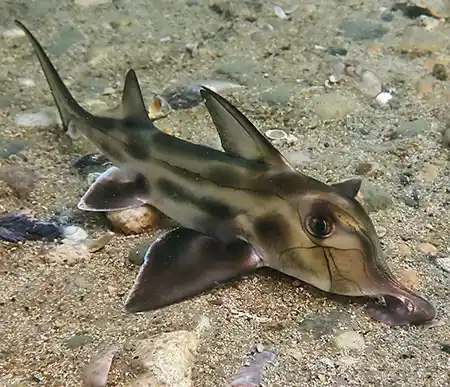
(Callorhinchus callorynchus)
Patagonian Elephantfish
Калоринх патагонський
It is found in the coastal waters of southern Brazil, Peru, Chile, Argentina, and Uruguay. It inhabits the open seas of the southeast Pacific Ocean and southwest Atlantic Ocean, with a preferred depth of approximately 200 m.
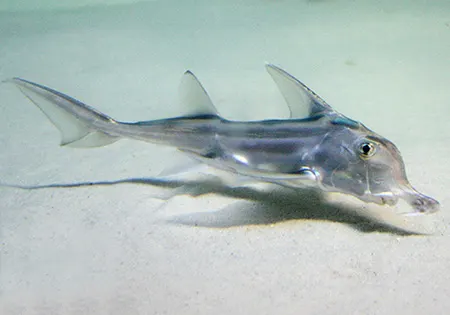
(Callorhinchus capensis)
Cape Elephantfish
Калоринх капський
It is found on continental shelves in waters surrounding South Africa and has been reported as far north as Natal and Namibia, at depths of up to 399 m.
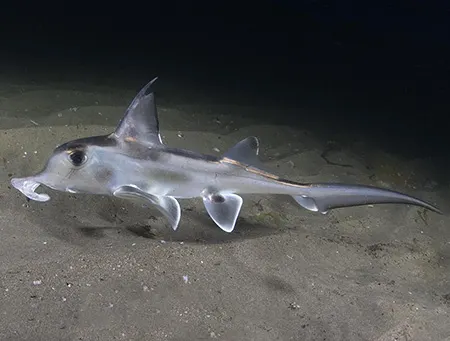
(Callorhinchus milii)
Australian Elephantfish
Калоринх австралійський
It is found off southern Australia, including Tasmania, and south of East Cape and Kaipara Harbour in New Zealand, at depths of 0–227 m.
