
(Pycnogonida)
Sea Spiders
Морські павуки
 Austrodecidae
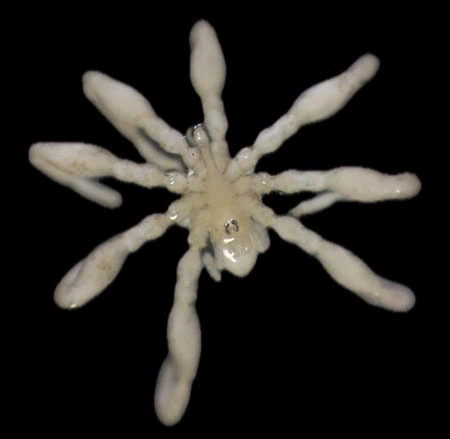 Ammotheidae
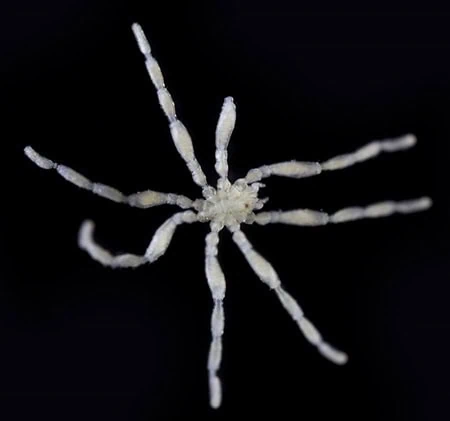
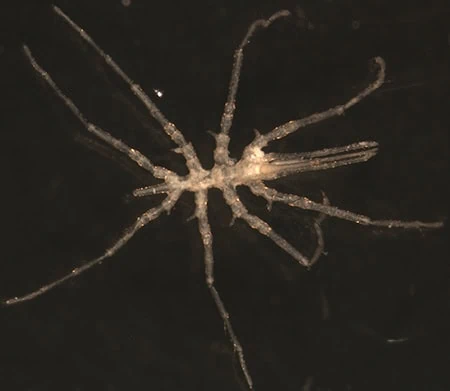
Sea spiders are marine arthropods of the class Pycnogonida, hence they are also called pycnogonids. The class includes the only extant order Pantopoda, alongside a few fossil species which could trace back to the early or mid-Paleozoic.
They are cosmopolitan, found in oceans around the world. The over 1,300 known species have leg spans ranging from 1 mm to over 70 cm. Most are toward the smaller end of this range in relatively shallow depths; however, they can grow to be quite large in the Antarctic region and in deep waters.
Sea spiders live in many different oceanic regions of the world, from Australia, New Zealand, and the Pacific coast of the United States, to the Mediterranean Sea and the Caribbean Sea, to the north and south poles. They are most common in shallow waters, but can be found as deep as 7,000 m, and live in both marine and estuarine habitats. Pycnogonids are well camouflaged beneath the rocks and among the algae that are found along shorelines.
Sea spiders are benthic in general, using their stilt-like legs to walk along the bottom, but they are also capable of swimming by using an umbrella pulsing motion and some Paleozoic species with flatter legs might have even had a nektonic lifestyle. Sea spiders are mostly carnivorous predators or scavengers that feed on soft-bodied invertebrates such as cnidarians, sponges, polychaetes, and bryozoans, by inserting their proboscis into targeted prey. Although they are known to feed on sea anemones, most sea anemones survive this ordeal, making the sea spider a parasite rather than a predator of sea anemones. A few species such as Nymphonella tapetis are specialized endoparasites of bivalve mollusks. Some species in the genus Sericosura are known to farm and consume methylotrophic bacteria on their exoskeletons.
Not much is known about the primary predators of sea spiders, if any. At least some species have obvious defensive methods such as amputating and regenerating their legs, or being distasteful via high levels of ecdysteroids (ecdysis hormone). In Pycnogonum litorale, the juveniles can regrow their posterior body section after being cut off, an ability which was thought to be absent in ecdysozoans. On the other hand, some parasites of sea spiders are known, including gastropod mollusks or hitch‐rided by sessile animals such as goose barnacles, which may negatively affect their locomotion and respiratory efficiency.
Reproduction and development
All sea spiders have separate sexes, except the only known hermaphroditic species Ascorhynchus corderoi and some extremely rare gynandromorph cases. Among all extant families, Austrodecidae and Rhynchothoracidae are the only two that still lack any observations on their reproductive behaviour and life cycle, as well as Colossendeidae until the mid 2020s. Reproduction involves external fertilisation when male and female stack together (usually male on top), exuding sperm and eggs from the gonopores of their respective leg coxae. After fertilisation, males glue the egg cluster with cement glands and using their ovigers (the oviger-lacking Nulloviger using only the ventral body wall) to carry the laid eggs and young. Colossendeidae is the only known exception that the egg mass was placed on substrate and well-camouflaged.
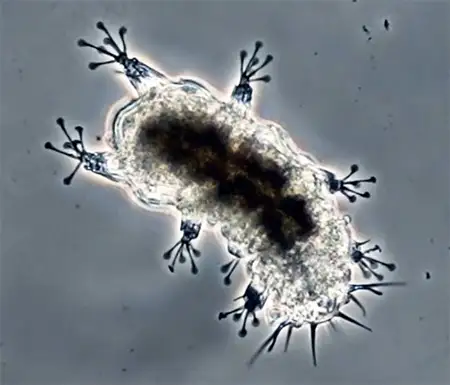
In most cases, the offsprings hatch as a distinct larval stage known as protonymphon. It has a blind gut and the body consists of a cephalon and its first three pairs of cephalic appendages only: the chelifores, palps and ovigers. In this stage, the chelifores usually have attachment glands, while the palps and ovigers are subequal, three-segmented appendages known as palpal and ovigeral larval limbs. When the larvae moult into the postlarval stage, they undergo transitional metamorphosis: the leg-bearing segments develop and the three pairs of cephalic appendages further develop or reduce. The postlarva eventually metamorphoses into a juvenile that looks like a miniature adult, which will continue to moult into an adult with a fixed number of walking legs. In Pycnogonidae, the ovigers are reduced in juveniles but reappear in oviger-bearing adult males.
These kinds of “head-only” larvae and their anamorphic metamorphosis resemble crustacean nauplius larvae and megacheiran larvae, all together they might reflect how the larvae of a common ancestor of all arthropods developed: starting its life as a tiny animal with a few head appendages, while new body segments and appendages were gradually added as it was growing.