
(Merostomata)
Horseshoe Crabs
Меростомові
Merostomata is a group of chelicerate arthropods that includes the extant horseshoe crabs (Xiphosura). The group has hardly changed in appearance in hundreds of millions of years; the modern horseshoe crabs look almost identical to prehistoric genera and are considered to be living fossils. The most notable difference between ancient and modern forms is that the abdominal segments in present species are fused into a single unit in adults.
Modern xiphosurans reach up to 79 cm in adult length, but the Paleozoic species were often far smaller, some as small as 1 to 3 cm long. Their bodies are divided into an anterior prosoma and a posterior opisthosoma, or abdomen. The upper surface of the prosoma is covered by a semicircular carapace, while the underside bears five pairs of walking legs and a pair of pincer-like chelicerae. The mouth is located on underside of the center of the prosoma, between the bases of the walking legs, and lies behind a lip-like structure called the labrum. The exoskeleton consist of a tough cuticle, but do not contain any crystalline biominerals. Like scorpions, xiphosurans have an exocuticular layer of hyaline which exhibits UV fluorescence.
Xiphosurans have up to four eyes, located in the carapace. Two compound eyes are on the side of the prosoma, with one or two median ocelli towards the front. The compound eyes are simpler in structure than those of other arthropods, with the individual ommatidia not being arranged in a compact pattern. They can probably detect movement, but are unlikely to be able to form a true image. In front of the ocelli is an additional organ that probably functions as a chemoreceptor.
The first four pairs of legs end in pincers, and have a series of spines, called the gnathobase, on the inner surface. The spines are used to masticate the food, tearing it up before passing it to the mouth. The fifth and final pair of legs, however, has no pincers or spines, instead having structures for cleaning the gills and pushing mud out of the way while burrowing. Behind the walking legs is a sixth set of appendages, the chilaria, which are greatly reduced in size and covered in hairs and spines. These are thought to be vestiges of the limbs of an absorbed first opisthosomal segment.
The opisthosoma is divided into a forward mesosoma, with flattened appendages, and a metasoma at the rear, which has no appendages. In modern forms, the whole of the opisthosoma is fused into a single unsegmented structure. The underside of the opisthosoma carries the genital openings and five pairs of flap-like gills.
The opisthosoma terminates in a long caudal spine, commonly referred to as a telson (though this same term is also used for a different structure in crustaceans). The spine is highly mobile, and is used to push the animal upright if it is accidentally turned over.
The mouth opens into a sclerotised oesophagus, which leads to a crop and gizzard. After grinding up its food in the gizzard, the animal regurgitates any inedible portions, and passes the remainder to the true stomach. The stomach secretes digestive enzymes, and is attached to an intestine and two large caeca that extend through much of the body, and absorb the nutrients from the food. The intestine terminates in a sclerotised rectum, which opens just in front of the base of the caudal spine.
Xiphosurans have well-developed circulatory systems, with numerous arteries that send blood from the long tubular heart to the body tissues, and then to two longitudinal sinuses next to the gills. After being oxygenated, the blood flows into the body cavity, and back to the heart. The blood contains haemocyanin, a blue copper-based pigment performing the same function as haemoglobin in vertebrates, and also has blood cells that aid in clotting.
The excretory system consists of two pairs of coxal glands connected to a bladder that opens near the base of the last pair of walking legs. The brain is relatively large, and, as in many arthropods, surrounds the oesophagus. In both sexes, the single gonad lies next to the intestine and opens on the underside of the opisthosoma.
Reproduction
Xiphosurans move to shallow water to mate. The male climbs onto the back of the female, gripping her with his first pair of walking legs. The female digs out a depression in the sand, and lays from 200 to 300 eggs, which the male covers with sperm. The pair then separates, and the female buries the eggs.
The egg is about 2–3 mm across. Inside the egg, the embryo goes through four molts before it hatches into a larva, often called a ‘trilobite larva’ due to its superficial resemblance to a trilobite. At this stage it has no telson yet, and the larva is lecithotrophic (non-feeding) and planktonic, subsisting on the maternal yolk before settling to the bottom to molt, after which the telson first appears. Through a series of successive moults, the larva develops additional gills, increases the length of its caudal spine, and gradually assumes the adult form. Modern xiphosurans reach sexual maturity after about three years of growth.
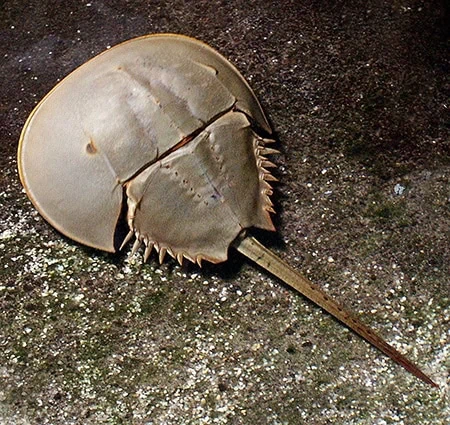
(Limulus polyphemus)
Atlantic Horseshoe Crab
Атлантичний мечохвіст
It is found in the Gulf of Mexico and along the Atlantic coast of North America. It inhabits shallow coastal habitats, including lagoons, estuaries and mangroves, as well as waters deeper than 200 m and up to 56 km offshore.
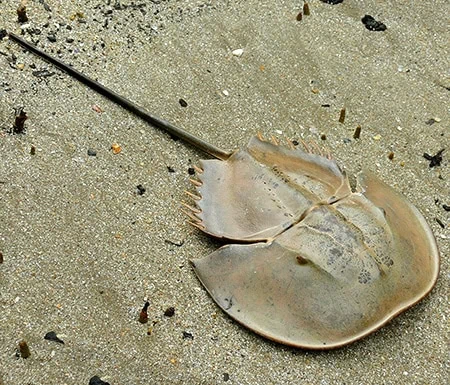
(Carcinoscorpius rotundicauda)
Mangrove Horseshoe Crab
Мангровий мечохвіст
It is found in tropical marine and brackish waters of India, Bangladesh, and Southeast Asia. It inhabits shallow waters with soft, sandy bottoms or extensive mud flats.
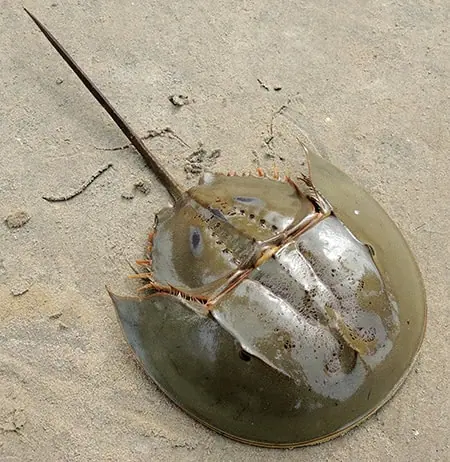
(Tachypleus gigas)
Indo-Pacific Horseshoe Crab
Південний мечохвіст
It is found in tropical South and Southeast Asia, ranging from the Bay of Bengal to the South China Sea, with records from India, Malaysia, Singapore, Indonesia, Thailand, Vietnam and the Philippines.
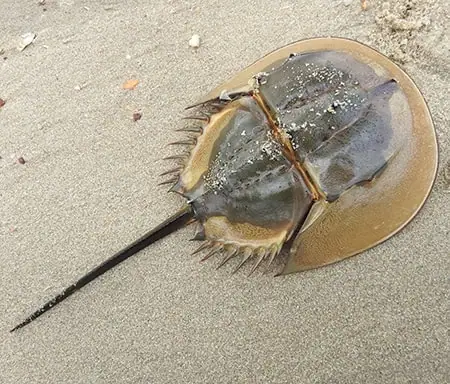
(Tachypleus tridentatus)
Chinese Horseshoe Crab
Китайський мечохвіст
It is found in Southeast and East Asia, with records from China, Indonesia, Japan, South Korea, Malaysia, the Philippines, Taiwan, and Vietnam. It is found in coastal marine and brackish waters.