
(Scalidophora)
Cephalorhynch Worms
Головохоботні
Scalidophora is a group of marine pseudocoelomate ecdysozoans that was proposed on morphological grounds to unite three phyla: the Kinorhyncha, the Priapulida and the Loricifera. The three phyla have four characters in common — chitinous cuticle that is moulted, rings of scalids on the introvert, flosculi, and two rings of introvert retracts. The introvert and abdomen are separated by a distinct neck region in all groups, but in adult macroscopic priapulids it becomes rudimentary in Priapulus and is completely absent in Halicryptus.
Kinorhyncha
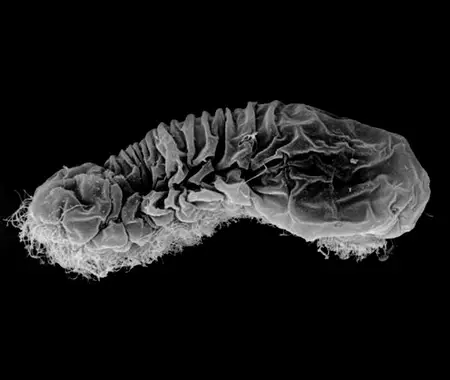
It is a phylum of small marine invertebrates that are widespread in mud or sand at all depths as part of the meiobenthos. They are commonly called mud dragons. Modern species are 1 mm or less, but Cambrian forms could reach 4 cm.
Kinorhynchs are limbless animals, with a body consisting of a head, neck, and a trunk of eleven segments. They are the only members of Ecdysozoa, except from the panarthropoda, with a segmented body; a feature that probably evolved independently from them. Juveniles have eight or nine segments, depending on genus, with the last two or three being added later during growth. A Cambrian species, Eokinorhynchus rarus, had about twice as many segments as present forms. Like other ecdysozoans they do not have external cilia, but instead have a number of spines along the body, plus up to seven circles of spines around the head. These spines are used for locomotion, withdrawing the head and pushing forward, then gripping the substrate with the spines while drawing up the body.
Kinorhynchs eat either diatoms or organic material found in the mud, depending on species. The mouth is located in a conical structure at the apex of the head, and opens into a pharynx and then an oesophagus, both of which are lined by cuticle. Two pairs of salivary glands and one or more pairs of “pancreatic glands” connect to the oesophagus and presumably secrete digestive enzymes. Beyond the oesophagus lies a midgut that combines the functions of a stomach and intestine, and lacks a cuticle, enabling it to absorb nutrients. The short hind-gut is lined by cuticle, and empties into an anus at the posterior end of the trunk.
There is no circulatory system, although the body cavity (pseudocoelom) is well developed, and includes amoebocytes. The excretory system consists of two protonephridia emptying through pores in the final segment.
The nervous system consists of a ventral nerve cord, with one ganglion in each segment, and an anterior nerve ring surrounding the pharynx. Smaller ganglia are also located in the lateral and dorsal portions of each segment, but do not form distinct cords. Some species have simple ocelli on the head, and all species have tiny bristles on the body to provide a sense of touch.
There are two sexes that look alike, although some sexual dimorphism in allometry has been reported. A pair of gonads are located in the mid-region of the trunk, and open to pores in the final segment. In most species, the sperm duct includes two or three spiny structures that presumably aid in copulation, although the details are unknown. Individual spermatozoa can reach a quarter of the total body length. The larvae are free-living, but little else is known of their reproductive process. After having laid an egg, the female packs it into a protective envelope of mud and organic material. There are six juvenile stages, during which segments are added and morphology is slightly modified.
Loricifera
Loricifera, also known as corset animals, is a phylum of very small to microscopic marine scalidophoran sediment-dwelling animals with 44 described species and approximately 100 more that have been collected and not yet described. Their sizes range from 100 μm to 1 mm.
They are characterized by a protective outer case known as a lorica and their habitat is in the spaces between marine gravel to which they attach themselves. They are among the most recently discovered groups of animals. They attach themselves quite firmly to the substrate, which is why they remained undiscovered for so long.They are found at all depths, in different sediment types, and in all latitudes.
The animals have a head, mouth, and digestive system, as well as the lorica. The head (which contains the mouth and the brain), a trunk region surrounded by six plates that make up the ‘lorica’ or corselet and–in between these two–the neck region. Loricifera has a well developed brain and scalids are individually connected to the brain by nerves. The armor-like lorica consists of a protective external shell or case of encircling plicae. They do not have a circulatory system or endocrine system. Many of the larvae are acoelomate, with some adults being pseudocoelomate, and some remaining acoelomate. Development is generally direct, though there are Higgins-larvae, which have toes and two or three pairs of hair-like structures from the backs of their loricas. Most adults are gonochoric. Very complex and plastic life cycles of pliciloricids include also paedogenetic stages with different forms of parthenogenetic reproduction. Loricifera is mostly dioecious, meaning there are males and females. However, there are a few species known to be hermaphroditic, which means they contain both male and female reproductive organs. Fossils have been dated to the late Cambrian.
Priapulida
Priapulida, sometimes referred to as penis worms, is a phylum of unsegmented marine worms.
They live in the mud, except for a few tropical meiobenthic species which live in medium- to coarse-grained sands, and are found in comparatively shallow waters to deep waters, with the larger forms like Priapulidae being restricted to colder environments, and smaller forms like Tubiluchus requiring warmer temperatures. Most meiobenthic forms live as shallow as 0.5 m, and Priapulus abyssorum has been found on depths of 3000–8000 m. Some species show a remarkable tolerance for hydrogen sulfide, anoxia and low salinity. Halicryptus spinulosus appears to prefer brackish shallow waters. They can be quite abundant in some areas. In an Alaskan bay as many as 85 adult individuals of Priapulus caudatus per square meter has been recorded, while the density of its larvae can be as high as 58,000 per square meter. They feed on slow-moving invertebrates, such as polychaete worms. Twenty-two extant species of priapulid worms are known, half of them being of meiobenthic size.
Priapulids are cylindrical worm-like animals, ranging from about 0.2 to 39 cm long, with a median anterior mouth quite devoid of any armature or tentacles. They show both radial and bilateral symmetry. The gonads, protonephridia and ventral nerve cord are bilateral, while the introvert, pharynx and brain show radial symmetry, which appears to be a secondary trait. The larvae also show internal and external characteristics of radial symmetry. The adult body is divided into a main trunk or abdomen and a somewhat swollen proboscis region ornamented with longitudinal ridges. In addition, it is ringed and often has circles of spines, which are continued into the slightly protrusible pharynx. Family Priapulidae have species with a tail or a pair of caudal appendages. A slender tail or tail filament is also found in family Tubiluchidae. Appendages are absent in the remaining families. The body has a chitinous cuticle that is moulted as the animal grows. Members of the family Chaetostephanidae also secrete a gelatinous tube, open in both ends, which they live in.
There is a wide body-cavity, which has no connection with the renal or reproductive organs, so it is not a coelom; it is probably a blood-space or hemocoel. There are no vascular or respiratory systems, but the body cavity does contain phagocytic amoebocytes and cells containing the respiratory pigment haemerythrin.
The alimentary canal is straight, consisting of an eversible pharynx, an intestine, and a short rectum. The pharynx is muscular and lined by teeth. Three of the five extant families have gone through a significant miniaturization, becoming detritivores (Tubiluchidae and Meiopriapulidae) and filter feeders (Chaetostephanidae). The two remaining families of Priapulidae and Halicryptidae are larger carnivores that feed on other animals, although some species also consume detritus as larvae. The shape of the teeth reflect these different lifestyles, and seem to be adapted mainly towards grasping prey or raking detritus from the sediment into the mouth. The anus is terminal, although in Priapulus one or two hollow ventral diverticula of the body-wall stretch out behind it.
The nervous system consists of a nerve ring around the pharynx and a prominent cord running the length of the body with ganglia and longitudinal and transversal neurites consistent with an orthogonal organisation. The nervous system retains a basiepidermal configuration with a connection to the ectoderm, forming part of the body wall. There are no specialized sense organs, but there are sensory nerve endings in the body, especially on the proboscis.
The priapulids are gonochoristic, having two separate sexes (i.e. male and female). Their male and female organs are closely associated with the excretory protonephridia. They comprise a pair of branching tufts, each of which opens to the exterior on one side of the anus. The tips of these tufts enclose a flame-cell like those found in flatworms and other animals, and these probably function as excretory organs. As the animals mature, diverticula arise on the tubes of these organs, which develop either spermatozoa or ova. These sex cells pass out through the ducts. The perigenital area of the genus Tubiluchus exhibits sexual dimorphism.
For the species Priapulus caudatus, the 80 μm egg undergoes a total and radial cleavage following a symmetrical and subequal pattern. Development is remarkably slow, with the first cleavage taking place 15 hours after fertilization, gastrulation after several days and hatching of the first ‘lorica’ larvae after 15 to 20 days. The species Meiopriapulus fijiensis have direct development. In current systematics, they are described as protostomes, despite having a deuterostomic development.