

(Sphenisciformes)
Penguins
Пінгвінові
Penguins are a group of flightless semi-aquatic sea birds which live almost exclusively in the Southern Hemisphere. Only one species, the Galapagos penguin, lives at, and slightly north of, the equator. Highly adapted for life in the ocean water, penguins have countershaded dark and white plumage and flippers for swimming. Most penguins feed on krill, fish, squid and other forms of sea life which they catch with their bills and swallow whole while swimming. A penguin has a spiny tongue and powerful jaws to grip slippery prey.
They spend about half of their lives on land and the other half in the sea. The largest living species is the emperor penguin (Aptenodytes forsteri): on average, adults are about 1.1 m tall and weigh 35 kg. The smallest penguin species is the little blue penguin (Eudyptula minor), also known as the fairy penguin, which stands around 30–33 cm tall and weighs 1.2–1.3 kg. Today, larger penguins generally inhabit colder regions, and smaller penguins inhabit regions with temperate or tropical climates. Some prehistoric penguin species were enormous: as tall or heavy as an adult human. There was a great diversity of species in subantarctic regions, and at least one giant species in a region around 2,000 km south of the equator 35 mya, during the Late Eocene, a climate decidedly warmer than today.
Anatomy and physiology
Penguins are superbly adapted to aquatic life. Their wings have evolved to become flippers, useless for flight in the air. In the water, however, penguins are astonishingly agile. Penguins’ swimming looks very similar to birds’ flight in the air. Within the smooth plumage a layer of air is preserved, ensuring buoyancy. The air layer also helps insulate the birds in cold waters. On land, penguins use their tails and wings to maintain balance for their upright stance.
All penguins are countershaded for camouflage – that is, they have black backs and wings with white fronts. A predator looking up from below (such as an orca or a leopard seal) has difficulty distinguishing between a white penguin belly and the reflective water surface. The dark plumage on their backs camouflages them from above.
Gentoo penguins are the fastest underwater birds in the world. They are capable of reaching speeds up to 36 km (about 22 miles) per hour while searching for food or escaping from predators. They are also able to dive to depths of 170–200 m. The small penguins do not usually dive deep; they catch their prey near the surface in dives that normally last only one or two minutes. Larger penguins can dive deep in case of need. Emperor penguins are the world’s deepest-diving birds. They can dive to depths of approximately 550 m while searching for food.
Penguins either waddle on their feet or slide on their bellies across the snow while using their feet to propel and steer themselves, a movement called “tobogganing”, which conserves energy while moving quickly. They also jump with both feet together if they want to move more quickly or cross steep or rocky terrain.
Penguins have an average sense of hearing for birds; this is used by parents and chicks to locate one another in crowded colonies. Their eyes are adapted for underwater vision and are their primary means of locating prey and avoiding predators; in air it has been suggested that they are nearsighted, although research has not supported this hypothesis.
Penguins have a thick layer of insulating feathers that keeps them warm in water (heat loss in water is much greater than in air). The emperor penguin has a maximum feather density of about nine feathers per square centimeter which is actually much lower than other birds that live in Antarctic environments. However, they have been identified as having at least four different types of feather: in addition to the traditional feather, the emperor has afterfeathers, plumules, and filoplumes. The afterfeathers are downy plumes that attach directly to the main feathers and were once thought to account for the bird’s ability to conserve heat when under water; the plumules are small down feathers that attach directly to the skin, and are much more dense in penguins than other birds; lastly the filoplumes are small (less than 1 cm long) naked shafts that end in a splay of fibers— filoplumes were thought to give flying birds a sense of where their plumage was and whether or not it needed preening, so their presence in penguins may seem inconsistent, but penguins also preen extensively.
The emperor penguin has the largest body mass of all penguins, which further reduces relative surface area and heat loss. They also are able to control blood flow to their extremities, reducing the amount of blood that gets cold, but still keeping the extremities from freezing. In the extreme cold of the Antarctic winter, the females are at sea fishing for food, leaving the males to brave the weather by themselves. They often huddle together to keep warm and rotate positions to make sure that each penguin gets a turn in the centre of the heat pack.
Calculations of the heat loss and retention ability of marine endotherms suggest that most extant penguins are too small to survive in such cold environments. In 2007, Thomas and Fordyce wrote about the “heterothermic loophole” that penguins utilize in order to survive in Antarctica. All extant penguins, even those that live in warmer climates, have a counter-current heat exchanger called the humeral plexus. The flippers of penguins have at least three branches of the axillary artery, which allows cold blood to be heated by blood that has already been warmed and limits heat loss from the flippers. This system allows penguins to efficiently use their body heat and explains why such small animals can survive in the extreme cold.
They can drink salt water because their supraorbital gland filters excess salt from the bloodstream. The salt is excreted in a concentrated fluid from the nasal passages.
Around one in 50,000 penguins (of most species) are born with brown rather than black plumage. These are called isabelline penguins. Isabellinism is different from albinism. Isabelline penguins tend to live shorter lives than normal penguins, as they are not well-camouflaged against the deep and are often passed over as mates.
Breeding
Penguins for the most part breed in large colonies, the exceptions being the yellow-eyed and Fiordland species; these colonies may range in size from as few as 100 pairs for gentoo penguins to several hundred thousand in the case of king, macaroni and chinstrap penguins. Living in colonies results in a high level of social interaction between birds, which has led to a large repertoire of visual as well as vocal displays in all penguin species. Agonistic displays are those intended to confront or drive off, or alternately appease and avoid conflict with, other individuals.
Penguins form monogamous pairs for a breeding season, though the rate the same pair recouples varies drastically. Most penguins lay two eggs in a clutch, although the two largest species, the emperor and the king penguins, lay only one. With the exception of the emperor penguin, where the male does it all, all penguins share the incubation duties. These incubation shifts can last days and even weeks as one member of the pair feeds at sea.
Penguins generally only lay one brood per year; the exception is the little penguin, which can raise two or three broods in a season.
Penguin eggs are smaller than any other bird species when compared proportionally to the weight of the parent birds; at 52 g, the little penguin egg is 4.7% of its mothers’ weight, and the 450 g emperor penguin egg is 2.3%. The relatively thick shell forms between 10 and 16% of the weight of a penguin egg, presumably to reduce the effects of dehydration and to minimize the risk of breakage in an adverse nesting environment. The yolk, too, is large and comprises 22–31% of the egg. Some yolk often remains when a chick is born, and is thought to help sustain the chick if the parents are delayed in returning with food.
When emperor penguin mothers lose a chick, they sometimes attempt to “steal” another mother’s chick, usually unsuccessfully as other females in the vicinity assist the defending mother in keeping her chick. In some species, such as emperor and king penguins, the chicks assemble in large groups called crèches.
Distribution and habitat
Although almost all penguin species are native to the Southern Hemisphere, they are not found only in cold climates, such as Antarctica. In fact, only a few species of penguin actually live so far south. Several species live in the temperate zone; one, the Galápagos penguin, lives as far north as the Galápagos Islands, but this is only made possible by the cold, rich waters of the Antarctic Humboldt Current that flows around these islands. Also, though the climate of the Arctic and Antarctic regions is similar, there are no penguins found in the Arctic.
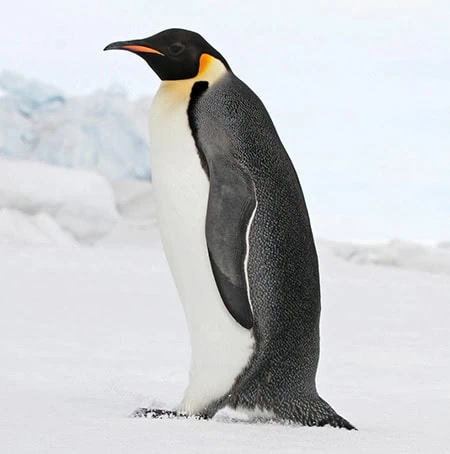
(Aptenodytes forsteri)
Emperor Penguin
Пінгвін імператорський
It has a circumpolar distribution in the Antarctic almost exclusively between the 66° and 77° south latitudes. It almost always breeds on stable pack ice near the coast and up to 18 km offshore.
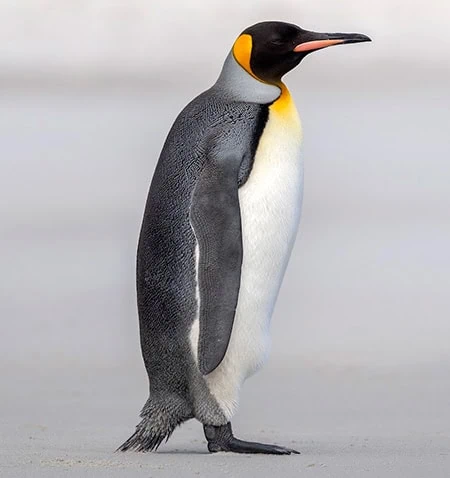
(Aptenodytes patagonicus)
King Penguin
Пінгвін королівський
It breeds on the subantarctic islands at the northern reaches of Antarctica, South Georgia, southern Argentina, and other temperate islands of the region. It also lives on Macquarie Island in the Southern Ocean and the Falkland Islands.
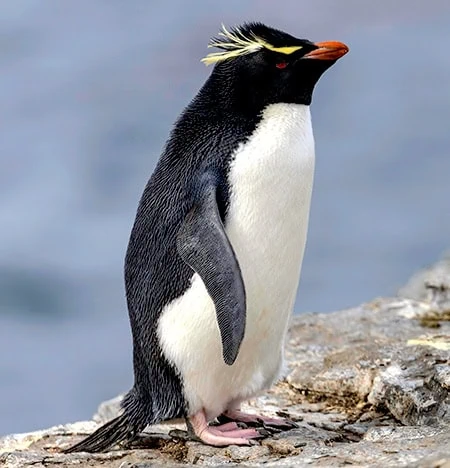
(Eudyptes chrysocome)
Western Rockhopper Penguin
Пінгвін західний чубатий
It is found in southern Argentina and Chile, and around the Falkland, Auckland, Kerguelen, Crozet, Macquarie, Prince Edward, Heard and McDonald, Campbell, Antipodes, Tristan da Cunha, Amsterdam, and Saint Paul islands.
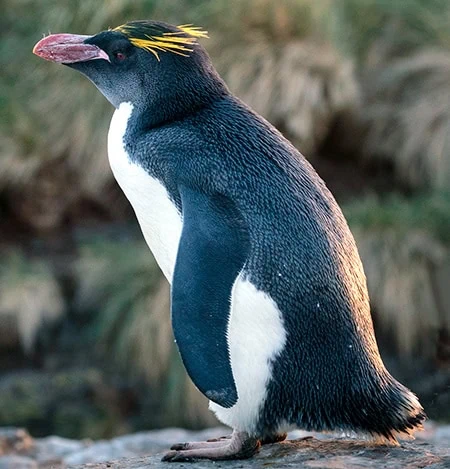
(Eudyptes chrysolophus)
Macaroni Penguin
Пінгвін золотоволосий
It is found in southern Chile, the Falkland Islands, the South Georgia and South Sandwich Islands, the South Orkney Islands, the South Shetland Islands, the Bouvet Island, the Prince Edward Islands, the Crozet Islands, the Kerguelen Islands, the Heard and McDonald Islands, and the Antarctic Peninsula.
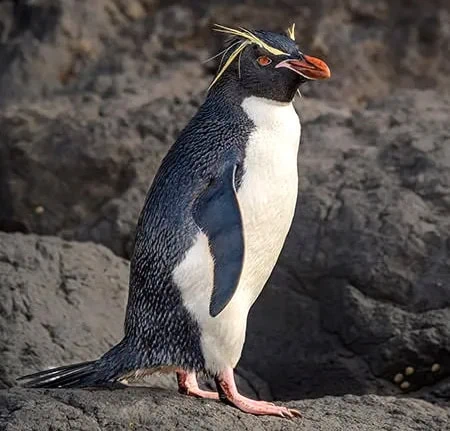
(Eudyptes filholi)
Eastern Rockhopper Penguin
Пінгвін східний чубатий
It is found in the southern Indian and Pacific oceans, from the Prince Edward Islands to the Antipodes Islands. It breeds on the Marion Islands, Macquarie Island, and subantarctic islands of New Zealand, including the Antipodes and Campbell Islands.
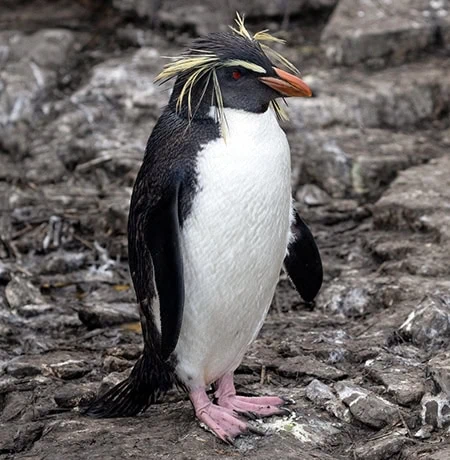
(Eudyptes moseleyi)
Moseley's Rockhopper Penguin
Пінгвін Мозлі
It breeds mainly on Tristan da Cunha and Gough Island in the South Atlantic Ocean. Breeding colonies are also found on Amsterdam Island and Saint Paul Island in the French Southern and Antarctic Lands.
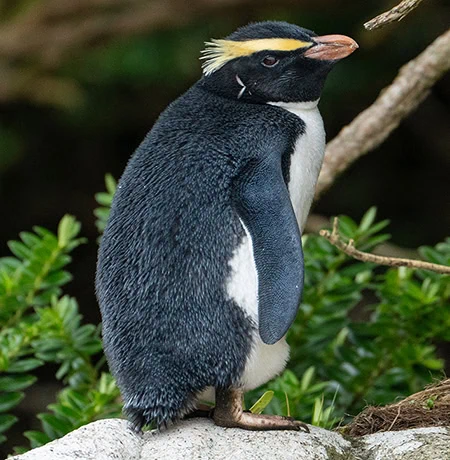
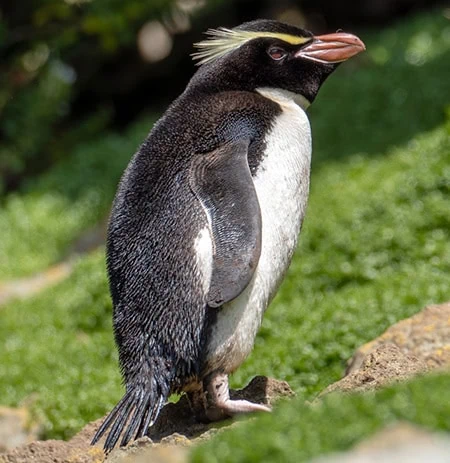
(Eudyptes pachyrhynchus)
Fiordland Penguin
Пінгвін новозеландський
It breeds in New Zealand along the west coast of the South Island, south of about Bruce Bay and the Open Bay Islands, around Fiordland and Foveaux Strait, and on Stewart Island and its outlying islands.
(Eudyptes robustus)
Snares Penguin
Пінгвін снарський
It is endemic to the Snares Islands, near New Zealand.
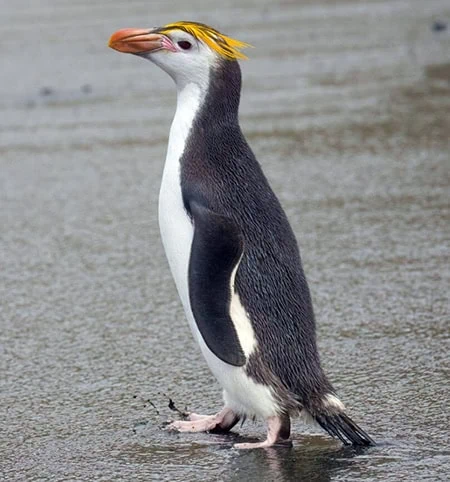
(Eudyptes schlegeli)
Royal Penguin
Пінгвін Шлегеля
It is endemic to the subantarctic Macquarie Island and the nearby Bishop and Clerk Islets in the Southern Ocean.
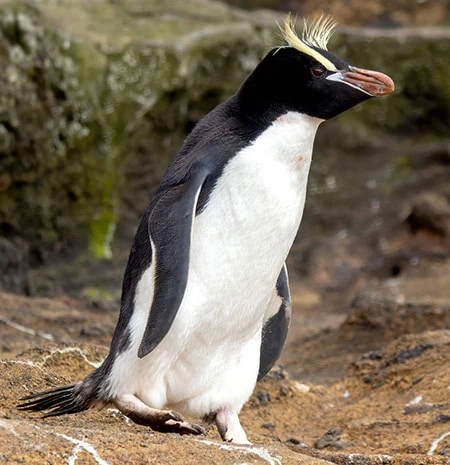
(Eudyptes sclateri)
Erect-crested Penguin
Пінгвін прямочубий
It is endemic to the New Zealand region and breeds only on the Bounty and Antipodes Islands.
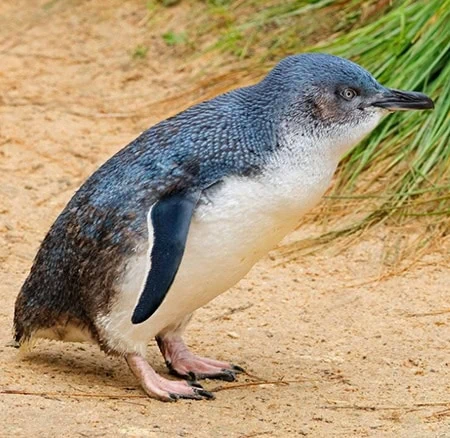
(Eudyptula minor)
Little Penguin
Пінгвін малий
It is found off South Australia and New Zealand, as well as on nearby islands.
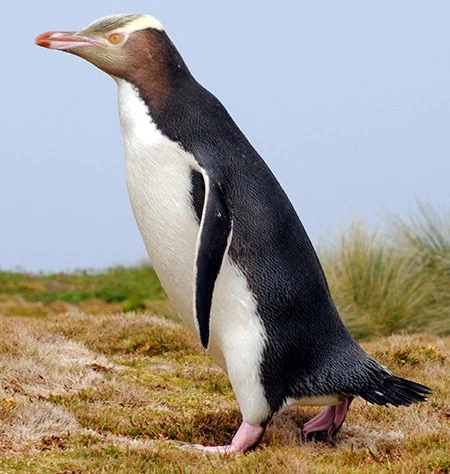
(Megadyptes antipodes)
Yellow-eyed Penguin
Пінгвін жовтоокий
It breeds along the eastern and south-eastern coastlines of the South Island of New Zealand, as well as Stewart Island, Auckland Islands, and Campbell Islands.
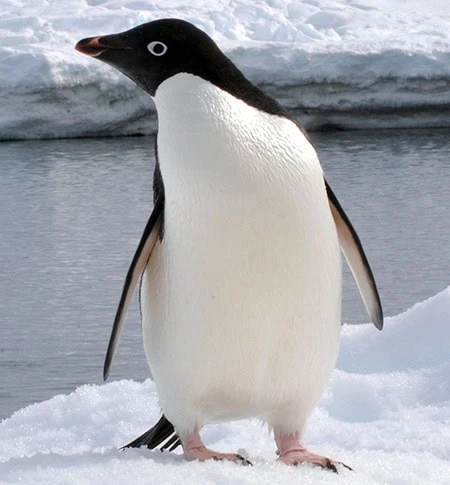
(Pygoscelis adeliae)
Adelie Penguin
Пінгвін Аделі
Its breeding colonies are scattered along Antarctica’s coasts and on a number of sub-Antarctic islands, including those in the South Orkneys, the South Shetlands, the South Sandwich Islands, the Balleny Islands, Scott Island and South Georgia.
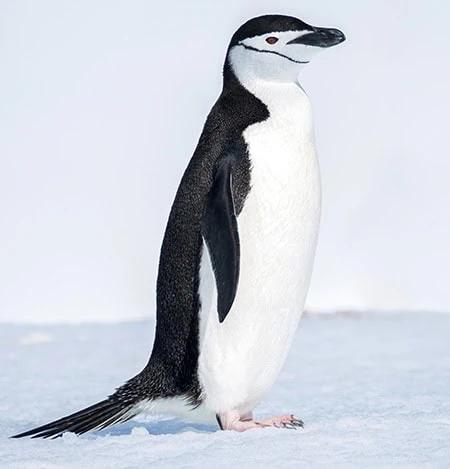
(Pygoscelis antarcticus)
Chinstrap Penguin
Пінгвін антарктичний
It has a circumpolar distribution. It breeds in Antarctica, Argentina, Bouvet Island, Chile, the French Southern Territories, and South Georgia and the South Sandwich Islands. Vagrant individuals have been found in New Zealand, Saint Helena, Tristan da Cunha, and South Africa.
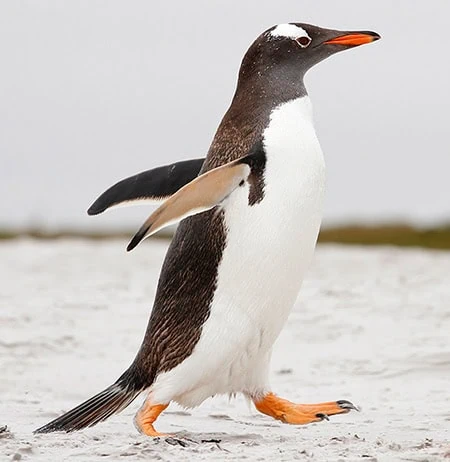
(Pygoscelis papua)
Gentoo Penguin
Пінгвін-шкіпер
The main colonies are on the Falkland Islands, South Georgia and the South Sandwich Islands and Kerguelen Islands; smaller colonies are found on: Macquarie Island, Heard Islands, Crozet Islands, South Shetland Islands and the Antarctic Peninsula.
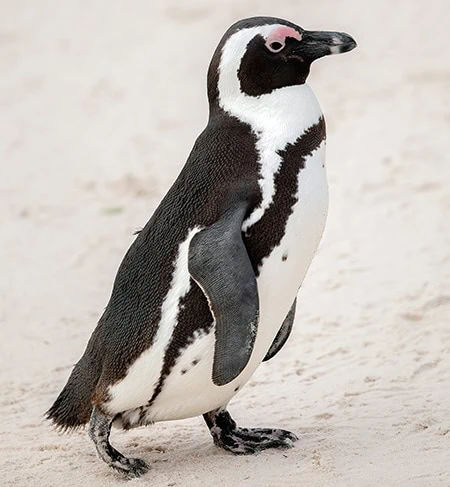
(Spheniscus demersus)
African Penguin
Пінгвін африканський
It is found on the southern and southwestern coast of Africa, living in colonies on 27 islands between Namibia and Algoa Bay, near Port Elizabeth, South Africa.
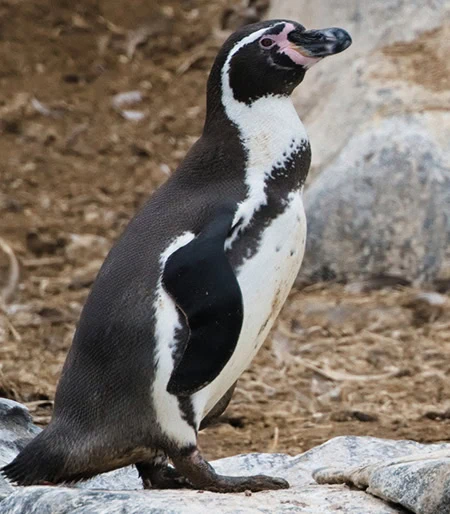
(Spheniscus humboldti)
Humboldt Penguin
Пінгвін Гумбольдта
It is endemic to the west coast of South America. Its breeding distribution ranges from southern Chile along the dry and arid coastal regions of the Atacama Desert to subtropical Isla Foca in northern Peru.
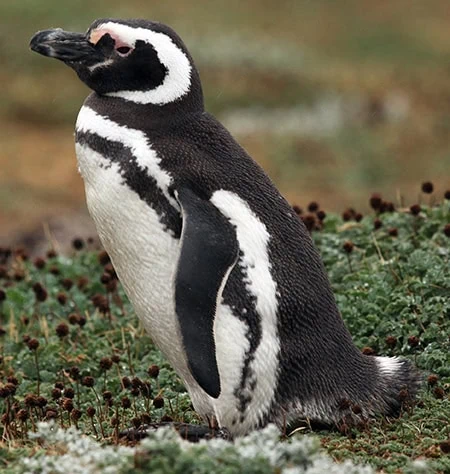
(Spheniscus magellanicus)
Magellanic Penguin
Пінгвін магеланський
It breeds along the coast of Patagonia, including Argentina, Chile, and the Falkland Islands, with some migrating to Brazil and Uruguay, where they are occasionally seen as far north as Espírito Santo.
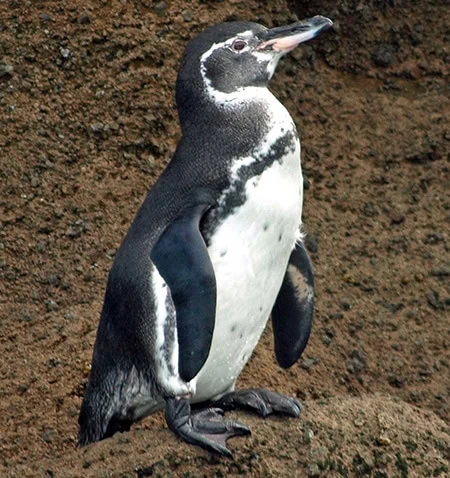
(Spheniscus mendiculus)
Galápagos Penguin
Пінгвін галапагоський
It is endemic to the Galápagos Islands of Ecuador. Most individuals inhabit Fernandina Island and the west coast of Isabela Island.