

(Hypsiprymnodontidae)
Rat-Kangaroos
Мускуснокенгурові
(Hypsiprymnodon moschatus)
Musky Rat-Kangaroo
Кенгуровий мускусний щур
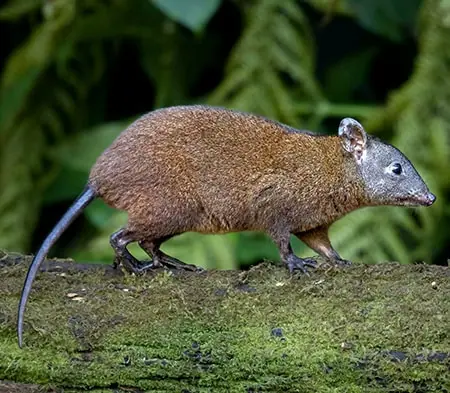
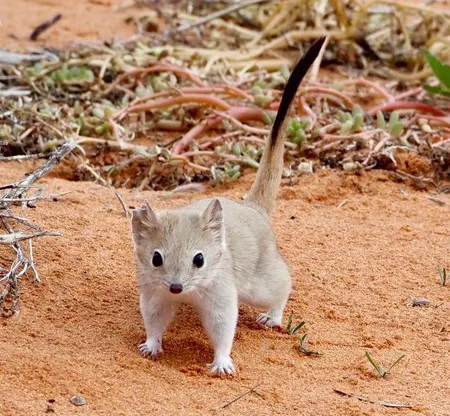
It only occurs in the north-eastern part of Australia. They may be locally common in remaining areas of extensive rainforest and can occur at high and low elevations. The distribution range extends from west of Ingham, Queensland at Mt. Lee to Mt. Amos south of Cooktown. They are found in low altitude rainforests, such as Cape Tribulation and Mission Beach, and within the montane habitat of the Carbine, Atherton and Windsor tableland regions.
A usually solitary animal that is only active during the day, distinguishing them from the nocturnal habits of the rat-kangaroos in the Potoroidae family. They are most active in the morning and afternoon, retiring to their shelter during the middle of the day. They are mostly terrestrial, foraging at the forest floor, although they are able to move through the branches of the lower vegetation.
A nest is roughly constructed at a site where the animal shelters while sleeping. The individual ranges overlap in both their foraging and nest site. Males may venture out in a range from 0.8 to 4.2 hectares, while females are recorded foraging over a smaller sized area of up to 2.2 ha. Although they are usually solitary in the activities, several may gather to feed at fallen fruit.
Their omnivorous diet comprises fruits and fungi along with some insects and other invertebrates, found among the leaf litter and lower storey of the rainforest. The composition of the diet has been described as omnivorous, perhaps with reduced capacity for the carnivory of some fossil species of propleonines, but other records suggest the diet is largely frugivorous.
Aggressive behaviours between males may be displayed during the austral spring and summer months, vigorously pursuing each other for around 30 seconds. The male’s encounters, sometimes in competition for fruit, increase in frequency during breeding months; physical interactions between the males are restricted to striking with the front paw. Reproductive activity is mostly from October to April, the usual litter size is two offspring. The newborns travel in the pouch of the mother for about 21 weeks, and then are left at the nest while the mother forages until the juveniles are fully weaned. The earliest records note that the animal was elusive and discreet in its nature, and that specimens were difficult to obtain.
Regular activity is conducted on all four limbs, but unlike the bettongs and potoroos, the musky rat-kangaroo bounds using all its paws when moving rapidly. This resembles the characteristic hopping of a rabbit more than that of its macropod relations. It moves by extending its body and then bringing both of its hind legs forward, and uses an opposable toe on the hind foot to climb trees.