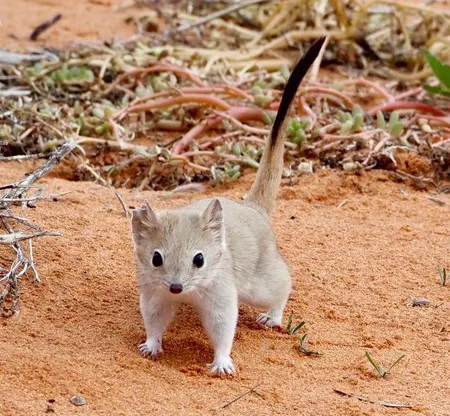


(Myrmecobiidae)
Numbats
Намбатові
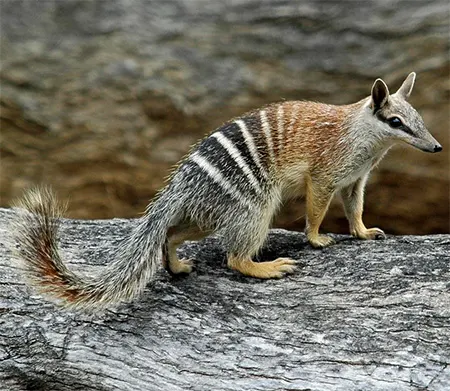
(Myrmecobius fasciatus)
Numbat
Намбат
It is widely distributed across southern Australia, from Western Australia to north-western New South Wales. However, their range has significantly decreased since the arrival of Europeans, and the species has survived only in two small patches of land in the Dryandra Woodland and the Tone-Perup Nature Reserve, both in Western Australia.
Today, numbats are naturally found only in areas of eucalypt forest, but they were once more widespread in other types of semiarid woodland, spinifex grassland, and in terrain dominated by sand dune. There are estimated to be fewer than 1,000 left in the wild.
Numbats are insectivores and subsist on a diet of termites (of the genera Heterotermes, Coptotermes, Amitermes, Microcerotermes, Termes, Paracapritermes, Nasutitermes, Tumulitermes, and Occasitermes). An adult numbat requires up to 20,000 termites each day. The only marsupial fully active by day, the numbat spends most of its time searching for termites. It digs them up from loose earth with its front claws and captures them with its long, sticky tongue. Because termites have a high water content Numbats obtain most of their water needs directly from their food, allowing them to survive in dry Australian habitats. Despite its banded anteater name, it apparently does not intentionally eat ants; although the remains of ants have occasionally been found in numbat excreta, these belong to species that themselves prey on termites, so were presumably eaten accidentally, along with the main food. Known native predators include various reptiles and raptors, such as the carpet python, sand goanna, wedge-tailed eagle, collared sparrowhawk, brown goshawk, and the little eagle. They are also preyed upon by invasive red foxes and feral cats.
Adult numbats are solitary and territorial; an individual male or female establishes a territory of up to 1,5 км² early in life, and defends it from others of the same sex. The animal generally remains within that territory from then on; male and female territories overlap, and in the breeding season, males will venture outside their normal home ranges to find mates.
While the numbat has relatively powerful claws for its size, it is not strong enough to get at termites inside their concrete-like mounds, and so must wait until the termites are active. It uses a well-developed sense of smell to locate the shallow and unfortified underground galleries that termites construct between the nest and their feeding sites; these are usually only a short distance below the surface of the soil, and vulnerable to the numbat’s digging claws.
The numbat synchronises its day with termite activity, which is temperature dependent: in winter, it feeds from midmorning to midafternoon; in summer, it rises earlier, takes shelter during the heat of the day, and feeds again in the late afternoon. Numbats can enter a state of torpor, which may last up to fifteen hours a day during the winter months.
At night, the numbat retreats to a nest, which can be in a log or tree hollow, or in a burrow, typically a narrow shaft 1–2 m long which terminates in a spherical chamber lined with soft plant material: grass, leaves, flowers, and shredded bark. The numbat is able to block the opening of its nest, with the thick hide of its rump to prevent a predator being able to accessing the burrow.
Numbats have relatively few vocalisations, but have been reported to hiss, growl, or make a repetitive ‘tut’ sound when disturbed.
Reproduction
Numbats breed in February and March (late austral summer), normally producing one litter a year. They can produce a second if the first is lost. Gestation lasts 15 days, and results in the birth of four young. Unusual for marsupials, female numbats have no pouch, although the four teats are protected by a patch of crimped, golden hair and by the swelling of the surrounding abdomen and thighs during lactation.
The young are 2 cm long at birth. They crawl immediately to the teats and remain attached until late July or early August, by which time they have grown to 7.5 cm. They are 3 cm long when they first develop fur, and the patterning of the adult begins to appear once they reach 5.5 cm. The young are left in a nest or carried on the mother’s back after weaning, becoming fully independent by November. Females are sexually mature by the following summer, but males do not reach maturity for another year.