

(Dasyuromorphia)
Carnivorous Marsupials
Кволоподібні
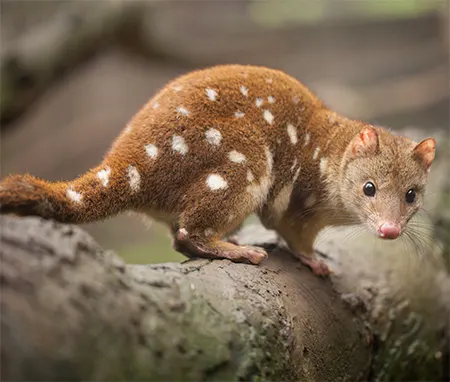 Dasyurids (dasyuridae)
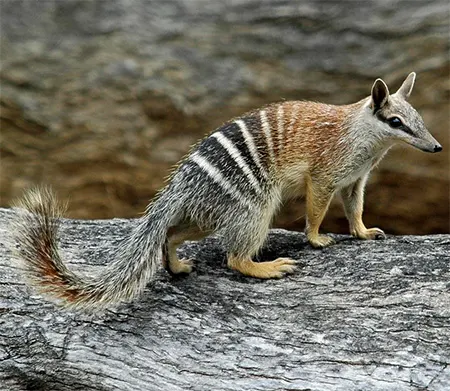 Numbats (myrmecobiidae)
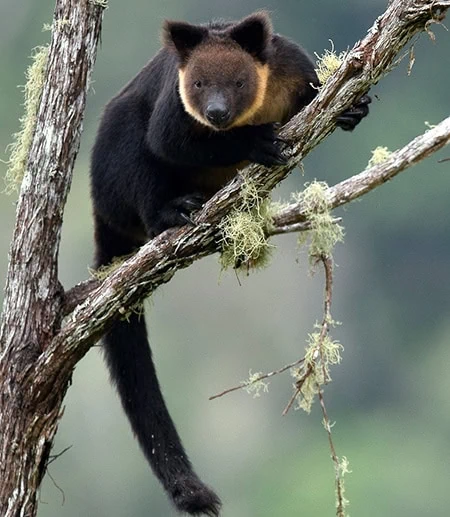
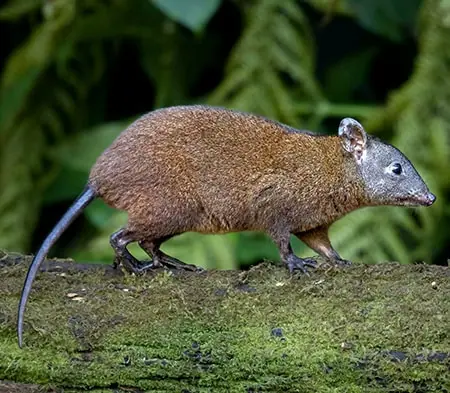
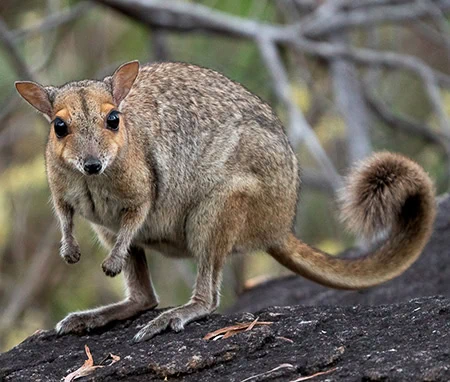
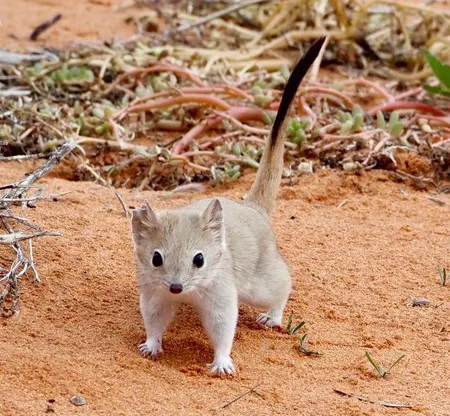
The order Dasyuromorphia includes 23 genera and about 80 species of carnivorous marsupials in three families: Dasyuridae (dasyurids), Myrmecobiidae (numbats), and Thylacinidae (thylacinids). Both Myrmecobiidae and Thylacinidae contain a single recent species, while Dasyuridae contains many species. The single species within Thylacinidae (Tasmanian wolf) is likely extinct. Dasyurids and thylacinids are more related to each other than they are to numbats.
Dasyuromorphs are nocturnal or crepuscular but occasionally forage or bask during the daytime. They exhibit long-range movements and often shift home ranges. Most species of dasyuromorphs are solitary and typically only form small groups while mating or rearing young. They build burrows and nests, which they add to during pregnancy and as young develop. Some species groom themselves, especially after feeding, which involves washing the face, snout, nape of the neck, throat and chin with licked forepaws. Dasyurids (Dasyuridae) use their forepaws not only to catch and eat prey but also in tactile social interactions where they grasp and pull one another.
To cope with unpredictably fluctuating food supplies, dasyuromorphs utilize a variety of strategies to conserve body heat and reduce energy expenditures. One strategy involves lowering metabolic rates when resources are particularly scarce. Because dasyuromorphs cannot sweat, they lick and pant to keep cool. Because of the diverse habitats in which they live, strategies to conserve body heat and reduce energy loss vary greatly. Strategies include having a spherical body shape to maximize heat conservation, increasing fur thickness in the winter, living in protected hollows during the day to avoid the heat, lining nests with leaves, and huddling in groups.
Reproduction
Both male and female dasyuromorphs practice promiscuous mating during a relatively short but intense breeding season. Larger males are more successful at attracting females and fighting off competing males. During courtship, males display antagonistic behavior in which they chase the female. During copulation, the male grips the female’s neck with his teeth and clasps her body with his forepaws to facilitate mounting. This continues throughout copulation, which lasts several hours. While copulating, males in the genus Antechinus can turn their bodies 180 degrees to ward off other males. After mating, males may guard a female for up to 12 hours to prevent other males from mating with her. Male Tasmanian devils are particularly aggressive during mate guarding and do not allow the female to leave her den for food or water for days. Occasionally females are able to escape these aggressive males but usually not without injury.
Females release pheromones to signal their receptivity to mate. They solicit males they find attractive and ward off other males. Females have long periods of behavioral estrous which allow them to mate with several males unless particularly aggressive males prohibit their ability to do so. Thus, multiple paternity as a result of sperm competition is often observed. For example, it is not uncommon for a litter of four Tasmanian devils to have four different fathers. Dasyurids (Dasyuridae) exhibit a unique form of sperm competition, and, other than bats, they are the only mammals in which females can store competing sperm within their reproductive tracts prior to ovulation.
asyuromorphs are either semelparous or iteroparous. Semelparity is very rare in mammals, having arisen only in dasyurids and didelphids. Semelparous dasyuromorphs, such as antechinuses, generally live in environments with predictable seasonal patterns of food abundance. It is thus advantageous to align reproductive patterns with seasonal variation in resource abundance. The mating season occurs in the winter when resources are scarce, and consequently young are born when resources are most abundant. Because seasonal patterns are so predictable, it not risky to dedicate all of their reproductive efforts into one brief mating season.
Males devote most of their energy to one big reproductive effort, and as a result have high concentrations of stress hormones in their blood. This inhibits inflammatory and immune responses and eventually kills the exhausted males. Females may survive for a second breeding season but almost never survive for a third. Semelparous dasyuromorphs are characterized by prolonged copulation, large testes size, male sexual dimorphism, mate guarding, long behavioral estrous of females, sperm storage in female reproductive tracts, high population densities, and sperm competition.
Iteroparous dasyuromorphs, on the other hand, reside in less restricted, less predictable environments. Therefore, it is risky to invest all of their energy into one reproductive effort when resource levels are so unpredictable. During the breeding season, Northern quolls exhibit normal levels of stress hormones and have larger body sizes and tail fat stores that help them survive to the next breeding season. Iteroparous dasyuromorphs do not display any of the identifying characteristics of semelparous dasyuromorphs. Additional reasons for semelparity in some species and iteroparity in others are not well understood.
After the brief mating season, male dasyuromorphs leave females with all parental responsibilities. In semelparous species, such as antechinuses, males die before their offspring are born.
Gestation time varies greatly with body size, as does time spent in the mother’s pouch. After leaving the pouch permanently, young are carried into well-hidden dens. Dens are lined with vegetation for protection and warmth and are located in underground burrows, caves or hollow logs. As young near weaning, mothers take more frequent trips outside of the den. When mothers begin to sleep away from their young, male offspring disperse from the den. Males move away from their mother’s home range while females remain in their mother’s home range for life.
During lactation, many dasyuromorph mothers are biased towards their male offspring and provide them with more nutrient-rich milk. Because larger males are more successful in attracting mates and reproducing, it is advantageous for mothers produce larger males that have a better chances of passing on her genes.
Lifespan/Longevity
The lifespan of dasyuromorphs varies greatly among the three families. Male numbats live up to 5 or 6 years in captivity, while females generally live longer. Little is known about Tasmanian wolves in the wild, and no information about their lifespan was recorded while they were still abundant. In captivity, however, they lived up to 12 years.
The lifespan of dasyurids is related to the amount of energy invested in early reproduction. Semelparous species, such as those in the genera Antechinus and Sminthopsis, invest heavily in one reproductive event and usually only live 1 to 2 years. Iteroparous species of dasyurids do not invest as much in early reproduction and live longer lives. For example, Tasmanian devils (Iteroparous dasyurids) live an average of 8 years in the wild.
Although small dasyurids appear short lived, they actually have long lifespans compared to similarly sized eutherians. Whereas small dasyurids live 1 to 2 years, mice live only 4 to 6 months. The reasons behind these differences are still unknown but appear to be related to differences in metatherian and eutherian physiology.
Communication and Perception
Due to their nocturnal habits, dasyuromorphs have reduced their dependence on sight for communication and perception and have adapted olfactory and auditory mechanisms to compensate. Dasyuromorphs utilize chemical signals such as scent markers as a primary mode of communication. Commonly used chemical signals include urine dribble, cloacal drag, chin rub, and sternal rub. These are used to mark territory or as a status signal during breeding. Other social behaviors, such as mouth sniffing, naso-nasal sniffing, touching, and cloacal sniffing have been observed. Cloacal sniffing is especially important in male-female interactions.
Auditory communication is also common in dasyuromorphs. Vocalizations are mostly associated with defensive situations, such as nest defense, food defense, and threats but are also used in parent-offspring interactions as well as courtship and mating. Dasyuromorphs emit a chatter, tail rattle, foot tap, huff, or bark as an alarm mechanism when they feel threatened or in danger. Defensive vocalizations include hisses, huffs, grunts, growls and screams. When separated from their mother, young dasyuromorphs produce vocalizations that trigger mother retrieval behavior.
Dasyuromorphs also possess vibrissae that orient their attacks during predation. Males use tactile communication during mounting and copulation by grasping the neck and abdomen of the female.
Food Habits
Dasyuomorphs are generalized predators that eat a wide range of invertebrate and vertebrate prey. Numbats are insectivorous, and one individual can consume 10,000 to 20,000 termites each day. Other families within Dasyuromorphia are carnivorous. They catch and eat both terrestrial and arboreal insects, including moths, beetles, and mosquitoes. Large species are also known to eat juvenile mice.
Vision and olfaction play key roles in hunting. Most dasyuromorph species possess vibrissae that help orient their attack toward prey; however, visual and tactile methods are also employed. Carnivorous marsupials bite or pin their prey with their forepaws. Bites are directed toward the anterior part of the body (head or neck) in order to assure capture. They are also known to shake and toss prey if they show resistance.
Predation
Dasyuromorph are vulnerable to reptilian, avian, and mammalian predators. They do not have any physical adaptations to deter predators and thus tend to minimize predation by foraging at night and under protective covering. Small dasyuromorphs are particularly vulnerable to introduced European red foxes. Domestic dogs, dingos, and domestic cats also prey upon dasyuromorphs.