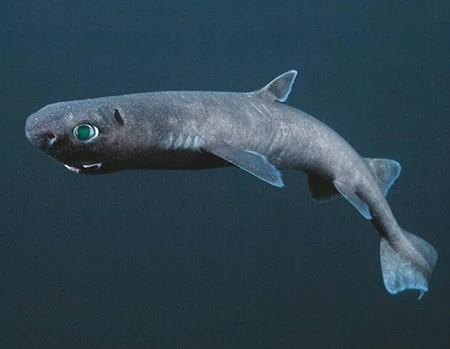


(Sphyrnidae)
Hammerhead Shark
Акули-молоти
The hammerhead sharks are a group of sharks that form the family Sphyrnidae, named for the unusual and distinctive form of their heads, which are flattened and laterally extended into a cephalofoil (a T-shape or “hammer”). The shark’s eyes are placed one on each end of this T-shaped structure, with their small mouths directly centered and underneath. Most hammerhead species are placed in the genus Sphyrna, while the winghead shark is placed in its own genus, Eusphyra. Many different—but not necessarily mutually exclusive—functions have been postulated for the cephalofoil, including sensory reception, manoeuvering, and prey manipulation. The cephalofoil gives the shark superior binocular vision and depth perception, as well as increased surface area for electrocreceptors.
Hammerheads are found worldwide, preferring life in warmer waters along coastlines and continental shelves. Unlike most sharks, some hammerhead species will congregate and swim in large schools during the day, becoming solitary hunters at night.
Hammerhead shark species vary in length and weight. The largest species, the great hammerhead, has an average length of 4 m and weight of 230 kg. The smallest species, the bonnethead shark, can reach 1.5 m in length and 10.8 kg in weight. One specimen caught off the Florida coast in 1906 weighed over 680 kg. They are usually light gray and have a greenish tint. Their bellies are white, which allows them to blend into the background when viewed from below and sneak up to their prey. Their heads have lateral projections that give them a hammer-like shape. While overall similar, this shape differs somewhat between species; examples are: a distinct T-shape in the great hammerhead, a rounded head with a central notch in the scalloped hammerhead, and an unnotched rounded head in the smooth hammerhead.
Hammerheads have disproportionately small mouths compared to other shark species. Some species are also known to form schools. In the evening, like most other sharks, they become solitary hunters. National Geographic explained that hammerheads can be found in warm, tropical waters, but during the summer, they begin a mass migration period in search of colder waters.
Cephalofoil
The hammer-like shape of the head may have evolved at least in part to enhance the animal’s vision. The positioning of the eyes, mounted on the sides of the shark’s distinctive hammer head, allows 360° of vision in the vertical plane, meaning the animals can see above and below them at all times. They also have an increased binocular vision and depth of visual field as a result of the cephalofoil. The shape of the head was previously thought to help the shark find food, aiding in close-quarters maneuverability, and allowing sharp turning movement without losing stability. The unusual structure of its vertebrae, though, has been found to be instrumental in making the turns correctly, more often than the shape of its head, though it would also shift and provide lift. From what is known about the winghead shark, the shape of the hammerhead apparently has to do with an evolved sensory function. Like all sharks, hammerheads have electroreceptory sensory pores called ampullae of Lorenzini. The pores on the shark’s head lead to sensory tubes, which detect electric fields generated by other living creatures. By distributing the receptors over a wider area, like a larger radio antenna, hammerheads can sweep for prey more effectively.
Reproduction
Reproduction occurs only once a year for hammerhead sharks, and usually occurs with the male shark biting the female shark violently until she agrees to mate with him. The hammerhead sharks exhibit a viviparous mode of reproduction with females giving birth to live young. Like other sharks, fertilization is internal, with the male transferring sperm to the female through one of two intromittent organs called claspers. The developing embryos are at first sustained by a yolk sac. When the supply of yolk is exhausted, the depleted yolk sac transforms into a structure analogous to a mammalian placenta (called a “yolk sac placenta” or “pseudoplacenta”), through which the mother delivers sustenance until birth. Once the baby sharks are born, they are not taken care of by the parents in any way. Usually, a litter consists of 12 to 15 pups, except for the great hammerhead, which gives birth to litters of 20 to 40 pups. These baby sharks huddle together and swim toward warmer water until they are old and large enough to survive on their own.
In 2007, the bonnethead shark was found to be capable of asexual reproduction via automictic parthenogenesis, in which a female’s ovum fuses with a polar body to form a zygote without the need for a male. This was the first shark known to do this.
Diet
Hammerhead sharks eat a large range of prey such as fish (including other sharks), squid, octopus, and crustaceans. Stingrays are a particular favorite, with the positioning of their (comparatively) smaller, crescent-shaped mouths underneath their T-shaped heads allowing for skilled skate, ray, and flounder hunting, among other seafloor-dwellers. These sharks will often be found swimming above the sand along the bottom of the ocean, stalking their prey. Their unique heads are further utilized as a tool (or weapon) if hunting rays and flatfishes; the shark uses its head to pin down and briefly stun the prey, and only eats once their quarry is clearly weakened and in shock. The great hammerhead, tending to be larger and more aggressive to its own kind than other hammerheads, occasionally engages in cannibalism, eating other hammerhead sharks, including mothers consuming their own young. In addition to the typical animal prey, bonnetheads have been found to feed on seagrass, which sometimes makes up as much as half their stomach contents. They may swallow it unintentionally, but they are able to partially digest it. At the time of discovery, this was the only known case of a potentially omnivorous species of shark (since then, whale sharks were also found to be omnivorous).
Relationship with humans
According to the International Shark Attack File, humans have been subjects of 17 documented, unprovoked attacks by hammerhead sharks within the genus Sphyrna since AD 1580. No human fatalities have been recorded. Most hammerhead shark species are too small to inflict serious damage to humans.
The great and the scalloped hammerheads are listed on the World Conservation Union’s (IUCN) 2008 Red List as endangered, whereas the smalleye hammerhead is listed as vulnerable. The status given to these sharks is as a result of overfishing and demand for their fins, an expensive delicacy.
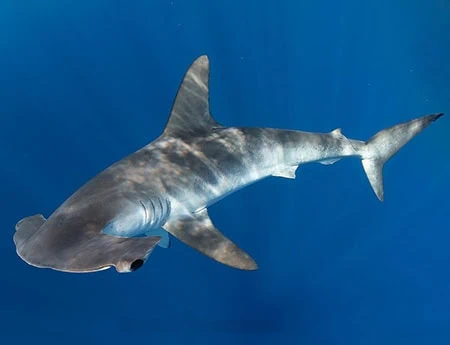
(Sphyrna zygaena)
Smooth Hammerhead
Акула-молот звичайна
It prefers temperate waters and occurs worldwide at medium latitudes. It prefers inshore waters such as bays and estuaries, but is also found in the open ocean over the continental shelf and around oceanic islands, at depths of 0–200 m.
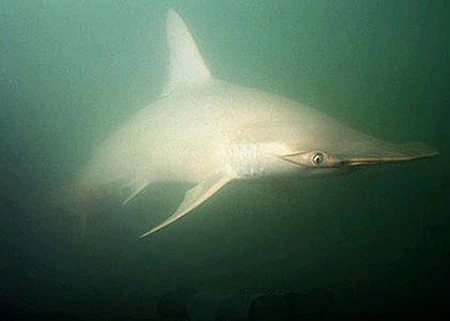
(Sphyrna tudes)
Smalleye Hammerhead
Акула-молот золота
It is found along the eastern coast of South America from Uruguay to Venezuela, though it seldom occurs further west than the Orinoco Delta southeast of Trinidad. It inhabits inshore murky waters 5–40 m deep, over muddy bottoms.
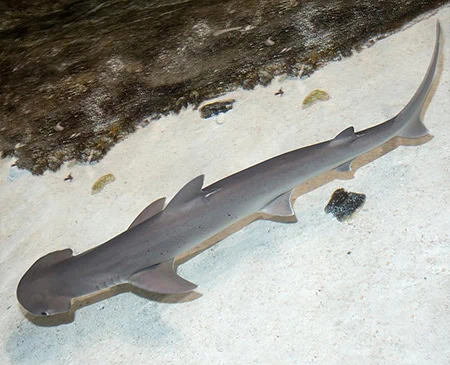
(Sphyrna tiburo)
Bonnethead
Акула-молот дрібноголова
It occurs on both sides of the American coast, in regions where the water is usually warmer than 21 °C, at depths of 10–80 m. In the Atlantic, it ranges from New England, where it is rare, to the Gulf of Mexico and Brazil, and in the Pacific it ranges from southern California to northern Peru.
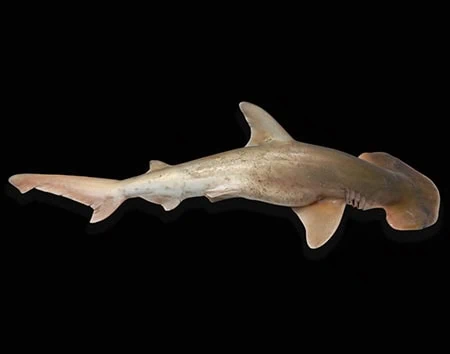
(Sphyrna vespertina)
Pacific Bonnethead
Акула-молот тихоокеанська
It is found in the eastern Pacific Ocean, from southern California south to northern Peru, including the Gulf of California.
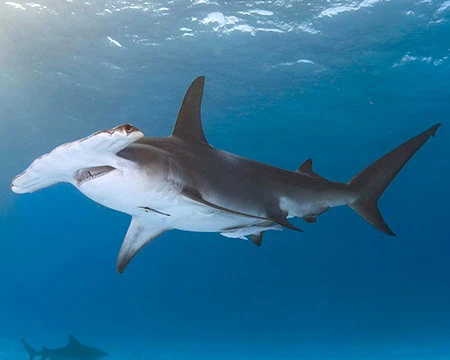
(Sphyrna mokarran)
Great Hammerhead
Акула-молот велика
It inhabits tropical waters around the world, between the latitudes of 40°N and 37°S. It may be found from inshore waters less than 1 m deep, to a depth of 80 m offshore. They favor coral reefs, but also inhabit continental shelves, island terraces, lagoons, and deep water near land.
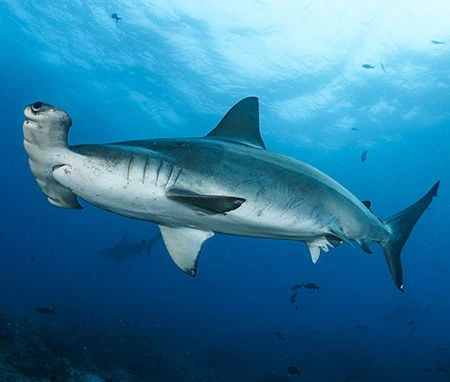
(Sphyrna lewini)
Scalloped Hammerhead
Акула-молот зубчаста
It occurs over continental and insular shelves and in nearby deeper water. It is found in warm temperate and tropical waters, worldwide from 46°N to 36°S. It can be found down to depths over 500 m, but is most often found above 25 m.
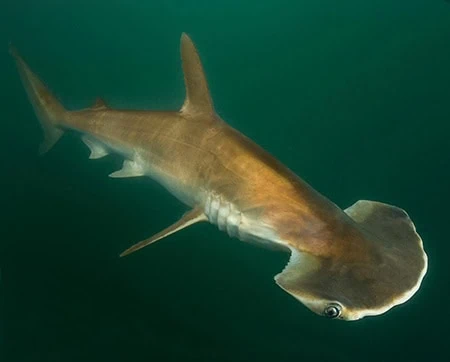
(Sphyrna media)
Scoophead
Акула-молот карибська
It inhabits the tropical waters of the western Atlantic Ocean, from Panama to southern Brazil, and in the eastern Pacific Ocean from the Gulf of California to Ecuador, and probably northern Peru, as well. It is found in shallow, inshore habitats.
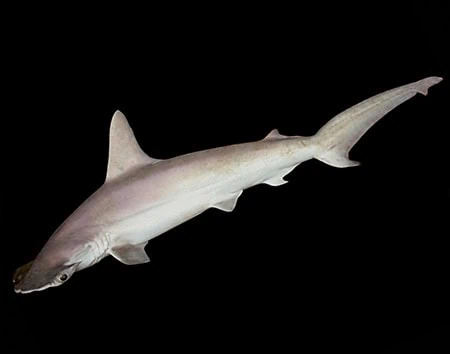
(Sphyrna gilberti)
Carolina Hammerhead
Акула-молот каролінська
It is found in the western Atlantic Ocean. Its pupping grounds are located in nearshore waters off the south-eastern United States, with the highest concentrations in Bulls Bay, South Carolina.
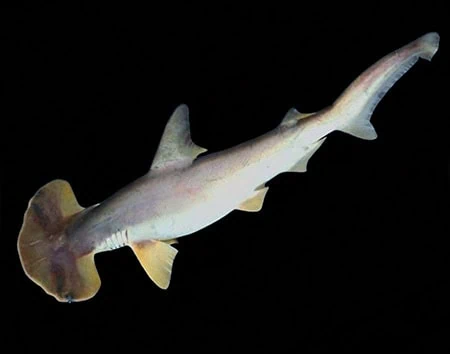
(Sphyrna corona)
Scalloped Bonnethead
Акула-молот круглоголова
It is found in tropical and subtropical waters in the eastern Pacific Ocean, from Mexico to Peru, and possibly as far north as the Gulf of California. It frequents inshore habitats over soft bottoms (mud, sand, and gravel) to a depth of 100 m, and also enters mangroves and estuaries.
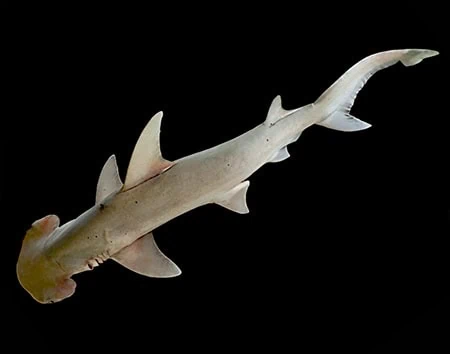
(Sphyrna alleni)
Caribbean Bonnethead
Акула-молот дрібноголова
It found along the West Atlantic coast from Belize to Brazil.
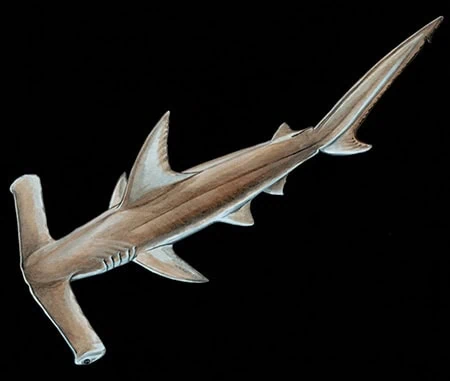
(Eusphyra blochii)
Winghead Shark
Акула-молот крилоголова
It is found in the tropical central and western Indo-Pacific, from the Persian Gulf eastward across South and Southeast Asia to New Guinea and northern Queensland. Its range extends as far north as Taiwan and as far south as the Montebello Islands off Western Australia. This species inhabits shallow waters close to shore and has been known to enter estuaries.
The genus (Eusphyra) also includes: (Eusphyra laticeps).