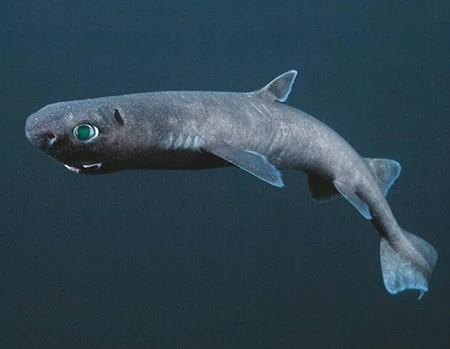


(Leptochariidae)
Barbeled Houndsharks
Вусаті собачі акули
(Leptocharias smithii)
Barbeled Houndshark
Вусата собача акула
The barbeled houndshark occurs along the western coast of Africa from Mauritania to northern Angola, though it may range as far north as the Mediterranean Sea. This species inhabits inshore waters 10–75 m deep, with temperatures of 20–27 °C, salinities of 35–36 ppt, and dissolved oxygen levels of 3–4 ppm. It is typically found close to the bottom over mud, particularly around river mouths.
The barbeled houndshark seems to be an active swimmer, based on its strong musculature, long tail, short trunk, and small liver. It feeds on a wide variety of bottom- and shore-dwelling organisms. Crustaceans (including crabs, lobsters, and shrimp) are favored prey, while small bony fishes (including sardines, anchovies, snake eels, blennies, gobies, and flatfish), skate and flying fish eggs, octopus, and sponges are also eaten; miscellaneous objects such as feathers, vegetable scraps, and flowers have also been recovered from its stomach. Known parasites of this species include the copepods (Eudactylina leptochariae) and (Thamnocephalus cerebrinoxius).
The enlarged anterior teeth of male barbeled houndsharks may function in mating behaviors. This species is viviparous; once the embryos exhaust their supply of yolk, they are nourished through a placental connection formed from the depleted yolk sac. Unlike any other shark, the yolk-sac placenta is globular or spherical. Off Senegal, females bear litters of seven pups around October, after a gestation period of at least four months. The largest fetuses on record measured 20 cm long, which is presumably close to the birth size. Males reach sexual maturity at 55–60 cm long, and females at 52–58 cm long.
Barbeled Houndshark, is a shallow inshore inhabitant of muddy coastal waters from Mauritania to Angola, in the eastern Atlantic. It has nasal barbels, which are presumed to assist it in detection of prey in turbid water when the line of sight is poor.