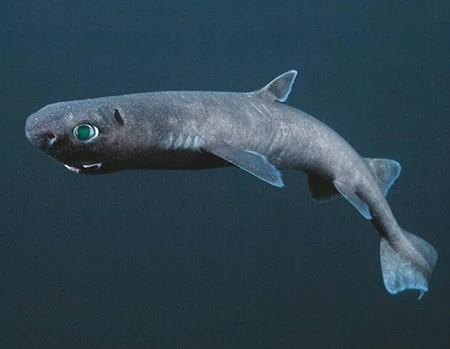


(Rhincodontidae)
Whale Sharks
Китові акули
(Rhincodon typus)
Whale Shark
Акула китова
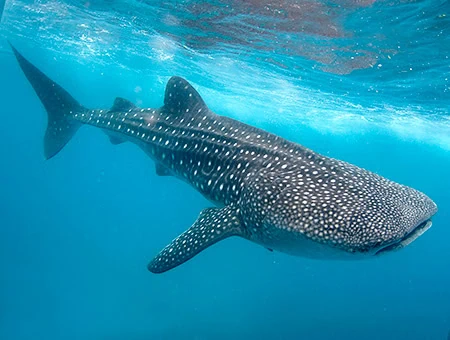
The whale shark inhabits all tropical and warm-temperate seas. The fish is primarily pelagic, and can be found in both coastal and oceanic habitats. Tracking devices have shown that the whale shark displays dynamic patterns of habitat utilization, likely in response to availability of prey. Whale sharks observed off the northeast Yucatan Peninsula tend to engage in inshore surface swimming between sunrise and mid-afternoon, followed by regular vertical oscillations in oceanic waters during the afternoon and overnight. About 95% of the oscillating period was spent in epipelagic depths (<200 m), but whale sharks also took regular deep dives (>500 m), often descending in brief “stutter steps”, perhaps for foraging. The deepest recorded dive was 1,928 m. Whale sharks were observed to remain continuously at depths of greater than 50 m for three days or more.
The whale shark is migratory and has two distinct subpopulations: an Atlantic subpopulation, from Maine and the Azores to Cape Agulhas, South Africa, and an Indo-Pacific subpopulation which holds 75% of the entire whale shark population. It usually roams between 30°N and 35°S where water temperatures are higher than 21 °C but have been spotted as far north as the Bay of Fundy, Canada and the Sea of Okhotsk north of Japan and as far south as Victoria, Australia.
Seasonal feeding aggregations occur at several coastal sites such as the Persian Gulf and Gulf of Oman, Ningaloo Reef in Western Australia, Darwin Island in the Galápagos, Quintana Roo in Mexico, Mafia Island of Pwani Region in Tanzania, Inhambane province in Mozambique, the Philippines, around Mahe in the Seychelles, the Gujarat and Kerala coasts of India, Taiwan, southern China and Qatar.
Growth and reproduction
Growth, longevity, and reproduction of the whale shark are poorly understood.
Vertebral growth bands have been used to estimate the age, growth, and longevity of whale sharks. However, there was uncertainty as to whether vertebrae growth bands are formed annually or biannually. A 2020 study compared the ratio of Carbon-14 isotopes found in growth bands of whale shark vertebrae to nuclear testing events in the 1950–60s, finding that growth bands are laid down annually. The study found an age of 50 years for a 10 m female and 35 years for a 9.9 m male. Various studies looking at vertebrae growth bands and measuring whale sharks in the wild have estimated their lifespans from ~80 years and up to ~130 years.
Evidence suggests that males grow faster than females in the earlier stages of life but ultimately reach a smaller maximum size. Whale sharks exhibit late sexual maturity. One study looking at free-swimming whale sharks estimated the age at maturity in males at ~25 years.
Pupping of whale sharks has not been observed, but mating has been witnessed twice in St Helena. Mating in this species was filmed for the first time in whale sharks off Ningaloo Reef via airplane in Australia in 2019, when a larger male unsuccessfully attempted to mate with a smaller, immature female.
The capture of a ~10.6 m female in July 1996 that was pregnant with ~300 pups indicated that whale sharks are ovoviviparous. The eggs remain in the body and the females give birth to live young which are 40 to 60 cm long. Evidence indicates the pups are not all born at once, but rather the female retains sperm from one mating and produces a steady stream of pups over a prolonged period.
Diet
The whale shark is a filter feeder – one of only three known filter-feeding shark species (along with the basking shark and the megamouth shark). It feeds on plankton including copepods, krill, chaetognaths, jellyfish, fish eggs, Christmas Island red crab larvae and small nektonic life, such as small squid or fish (sardines, anchovies, mackerels and small tunas). It also feeds on clouds of eggs during mass spawning of fish and corals. In addition, they have been found to ingest and partially digest Sargassum, thus making them omnivores. The many rows of vestigial teeth play no role in feeding. Feeding occurs either by ram filtration, in which the animal opens its mouth and swims forward, pushing water and food into the mouth, or by active suction feeding, in which the animal opens and closes its mouth, sucking in volumes of water that are then expelled through the gills. In both cases, the filter pads serve to separate food from water. These unique, black sieve-like structures are presumed to be modified gill rakers. Food separation in whale sharks is by cross-flow filtration, in which the water travels nearly parallel to the filter pad surface, not perpendicularly through it, before passing to the outside, while denser food particles continue to the back of the throat. This is an extremely efficient filtration method that minimizes fouling of the filter pad surface. Whale sharks have been observed “coughing”, presumably to clear a build-up of particles from the filter pads. Whale sharks migrate to feed and possibly to breed.
The whale shark is an active feeder, targeting concentrations of plankton or fish. It is able to ram filter feed or can gulp in a stationary position. This is in contrast to the passive feeding basking shark, which does not pump water. Instead, it swims to force water across its gills.
A juvenile whale shark is estimated to eat 21 kg of plankton per day.
Due to their mode of feeding, whale sharks are susceptible to the ingestion of microplastics. As such, the presence of microplastics in whale shark scat was recently confirmed.