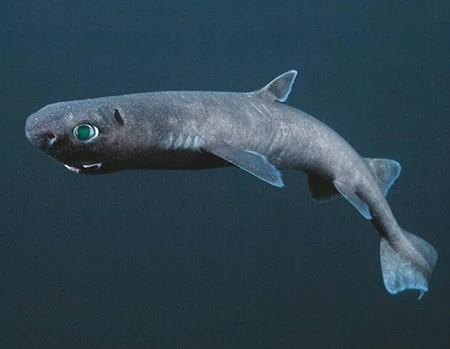


(Lamnidae)
White Sharks
Оселедцеві акули
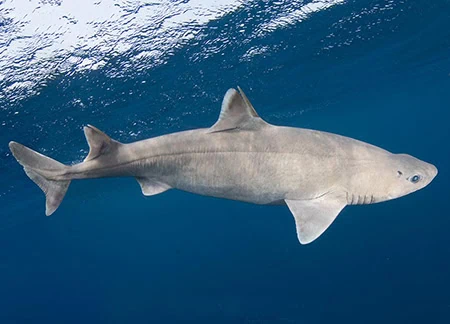
The Lamnidae are the family of mackerel sharks known as white sharks. They are large, fast-swimming predatory fish found in oceans worldwide, though they prefer environments with colder water. The name of the family is formed from the Greek word lamna, which means “fish of prey”, and was derived from the Greek legendary creature, the Lamia.
These sharks have pointed snouts, spindle-shaped bodies, and large gill openings. The first dorsal fin is large, high, stiff and angular or somewhat rounded. The second dorsal and anal fins are minute. The caudal peduncle has a couple of less distinct keels. The teeth are gigantic. The fifth gill opening is in front of the pectoral fin and spiracles are sometimes absent. They are powerful, heavily built sharks, sometimes weighing nearly twice as much as other sharks of comparable length from other families. Many sharks in the family are among the fastest-swimming fish, although the massive great white shark is slower due to its large size.
Carcharodon
The great white shark (Carcharodon carcharias), also known as the white shark, white pointer, or great white, is a large shark. It is closely related to the mako sharks, the porbeagle, and the salmon shark. It is a robustly built species with a grayish upperside and a white underside. The white shark is one of the largest living shark and fish species, though it is still smaller than the whale shark and basking shark. It has about 300 triangular, serrated teeth that are continuously replaced. Its massive, fatty liver can reach over a quarter of its body weight, providing buoyancy and storing energy. The species is partially warm-blooded, an adaptation that allows it to remain active in colder waters.
White sharks inhabit tropical and temperate ocean waters around the world and can be found both near coasts and in the open ocean. Populations are most concentrated at the Pacific and Atlantic sides of North America and in the waters of southern Africa and Oceania. They are a highly migratory species, traveling between the coast and the open ocean and even between continents. The white shark preys on marine mammals such as seals and dolphins, as well as squid and fish, including other sharks. It also scavenges whale carcasses. Though normally an apex predator, the species is sometimes preyed on by orcas. White sharks are generally solitary, but may gather in aggregations, particularly at feeding sites. They may communicate and establish dominance hierarchies with body language. The species reproduces with pups hatching from eggs inside the female before being born live. Juvenile white sharks typically inhabit shallower water and are limited to feeding on smaller prey.
The white shark has a fearsome reputation among the public. In reality, white sharks normally do not prey on humans, and the majority of bites are due to curiosity or possibly mistaken identity. Many attempts have been made to keep the species in captivity, but specimens either ended up dying or being released. White shark aggregations have attracted tourists who may view them from boats or from inside shark cages.
Isurus
Mako sharks are predatory mackerel sharks of the genus Isurus (meaning “equal tail”). They are largely pelagic, and are fast, predatory fish capable of swimming at speeds of up to 50 km/h. They occur at depths of 50–250 m. When hunting, they are capable of powerful leaps above the water surface. They feed primarily on bony fishes, sea turtles, other marine animals, and cephalopods. Both mako sharks are sexually dimorphic, with females being larger than males, and are large sharks. Both species of mako shark are classified as “Endangered” by the IUCN.
Reproduction is viviparous, with females producing litters of up to 18 pups measuring 70–120 cm at birth.
Lamna
Lamna is a genus of mackerel sharks in the family Lamnidae, containing two extant species: the porbeagle (Lamna nasus) of the North Atlantic and Southern Hemisphere, and the salmon shark (Lamna ditropis) of the North Pacific.
The total length of representatives of this genus ranges from 2 to 3.5 m, with a body mass of 25–31 kg. Males are somewhat smaller than females. The head is conical, and the mouth is large, with 25–31 rows of teeth. The eyes are large and positioned on the upper part of the head. There are five gill slits. The body is robust. One anal fin is present, along with one or two dorsal fins. The pectoral fins are broad. Coloration is bluish or brown on the back and sides, with a lighter underside marked by numerous dark spots.
Mackerel sharks inhabit generally shallow waters, down to a maximum depth of about 650 m, and may form small groups. They are capable of tolerating low temperatures, down to −15 to −18 °C. Their diet consists mainly of small to medium-sized bony fishes.
Sexual maturity in males occurs between 2 and 12 years of age, while females typically mature earlier. These sharks are ovoviviparous, with females giving birth to litters of 2–5 pups measuring 40–75 cm in length. Life expectancy is up to about 65 years.
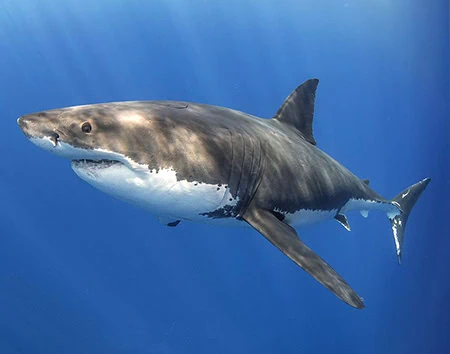
(Carcharodon carcharias)
Great White Shark
Велика акула біла
Its range from tropical to temperate and even colder waters around the world, with major populations in the northwestern and northeastern Pacific, western North Atlantic, the Mediterranean, southern African waters and Oceania. It is typically found near the surface, but may dive to depths of up to 1,300 m.
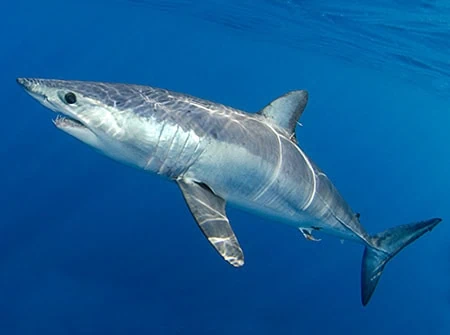
(Isurus oxyrinchus)
Shortfin Mako
Акула-мако сіро-блакитна
It is a cosmopolitan species, inhabiting offshore temperate and tropical seas worldwide. It occurs from the surface to depths of 150 m.
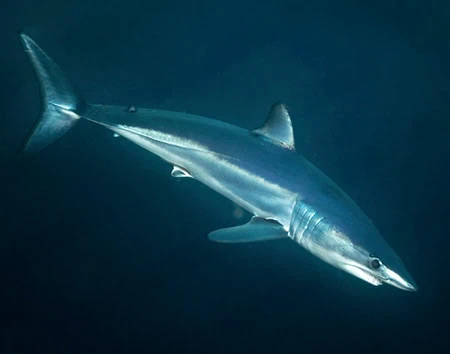
(Isurus paucus)
Longfin Mako
Мако довгоплавцева
It has a worldwide distribution in temperate and tropical waters, typically in areas with temperatures around 20–24 °C. It occurs at depths of 50–150 m.
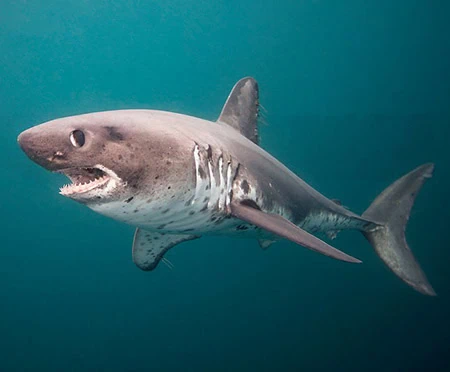
(Lamna ditropis)
Salmon Shark
Оселедцева акула тихоокеанська
It is found in the northern Pacific Ocean, where it is relatively common in continental offshore waters, ranging from inshore areas to just off the coast, at depths of 225–650 m. It is believed to extend as far south as the Sea of Japan and as far north as 65°N in Alaska.
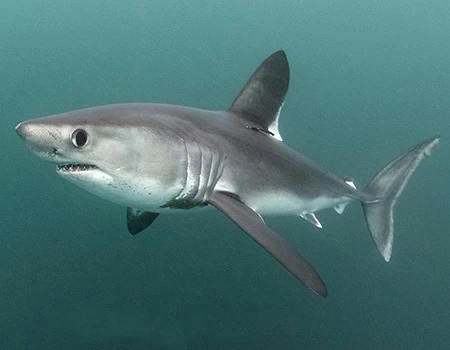
(Lamna nasus)
Porbeagle
Оселедцева акула атлантична
It is widely distributed in the northern Atlantic Ocean and occurs in the Bay of Biscay and the Mediterranean Sea. It is also found off southern Brazil, Argentina, and Chile, as well as off Australia, New Zealand, and South Africa. It occurs at depths of 0–1,360 m.