

(Cetorhinidae)
Basking Sharks
Велетенські акули
(Cetorhinus maximus)
Basking Shark
Акула велетенська
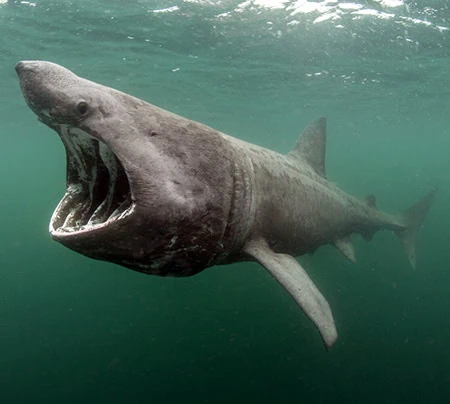
The basking shark (Cetorhinus maximus) is the second-largest living shark and fish, after the whale shark. It is one of three plankton-eating shark species, along with the whale shark and megamouth shark. Typically, basking sharks reach 7.9 m in length, but large individuals have been known to grow more than 10 m long. It is usually greyish-brown, with mottled skin, with the inside of the mouth being white in colour. The caudal fin has a strong lateral keel and a crescent shape.
The basking shark is a cosmopolitan migratory species found in all the world’s temperate oceans. A slow-moving filter feeder, its common name derives from its habit of feeding at the surface, appearing to be basking in the warmer water there. It has anatomical adaptations for filter-feeding, such as a greatly enlarged mouth and highly developed gill rakers. Its snout is conical, and the gill slits extend around the top and bottom of its head. The gill rakers, dark and bristle-like, are used to catch plankton as water filters through the mouth and over the gills. The teeth are numerous, often numbering 100 per row. The teeth are very small, have a single conical cusp, are curved backwards, and are the same on both the upper and lower jaws. This species has the smallest weight-for-weight brain size of any shark, reflecting its relatively passive lifestyle.
Basking sharks have been shown from satellite tracking to overwinter in both continental shelf (less than 200 m and deeper waters. They may be found either in small shoals or alone. Despite their large size and threatening appearance, basking sharks are not aggressive and are harmless to humans.
Range and habitat
The basking shark is a coastal-pelagic shark found worldwide in boreal to warm-temperate waters. It lives around the continental shelf and occasionally enters brackish waters. It is found from the surface down to at least 910 m. It prefers temperatures of 8 to 14.5 °C but has been confirmed to cross the much warmer waters at the equator. It is often seen close to land, including in bays with narrow openings. The shark follows plankton concentrations in the water column, so it is often visible at the surface. It characteristically migrates with the seasons.
Basking sharks do not hibernate and are active year-round. In winter, basking sharks often move to deeper depths, even down to 900 m and have been tracked making vertical movements consistent with feeding on overwintering zooplankton.
Social behaviour
Basking sharks are usually solitary, but during summer months in particular, they aggregate in dense patches of zooplankton, where they engage in social behaviour. They can form sex-segregated shoals, usually in small numbers (three or four), but reportedly up to 100 individuals. Small schools in the Bay of Fundy and the Hebrides have been seen swimming nose to tail in circles; their social behaviour in summer months has been studied and is thought to represent courtship.
Predators
Basking sharks have few predators. White sharks have been reported to scavenge on the remains of these sharks. Killer whales have been observed feeding on basking sharks off California in the US and New Zealand. Lampreys are often seen attached to them, although they are unlikely to be able to cut through the shark’s thick skin.
Diet
The basking shark is a ram feeder, filtering zooplankton, very small fish, and invertebrates from the water with its gill rakers by swimming forwards with its mouth open. A 5-metre-long basking shark has been calculated to filter up to 500 short tons of water per hour swimming at an observed speed of 0.85 metres per second. Basking sharks are not indiscriminate feeders on zooplankton. Samples taken in the presence of feeding individuals recorded zooplankton densities 75% higher than adjacent non-feeding areas. Basking sharks feed preferentially in zooplankton patches dominated by small planktonic crustaceans called calanoid copepods (on average 1,700 individuals per cubic metre of water). They will also feed on copepods of the genera Pseudocalanus and Oithona. Basking sharks sometimes congregate in groups of up to 1,400 spotted along the northeastern U.S. Samples taken near feeding sharks contained 2.5 times as many Calanus helgolandicus individuals per cubic metre, which were also found to be 50% longer. Unlike the megamouth shark and whale shark, the basking shark relies only on the water it pushes through its gills by swimming; the megamouth shark and whale shark can suck or pump water through their gills.
Reproduction
Basking sharks are ovoviviparous: the developing embryos first rely on a yolk sac, with no placental connection. Their seemingly useless teeth may play a role before birth in helping them feed on the mother’s unfertilized ova (a behaviour known as oophagy). In females, only the right ovary appears to function, and it is currently unknown why only one of the organs seems to function.
Gestation is thought to span over a year (perhaps two to three years), with a small, though unknown, number of young born fully developed at 1.5–2 m. Only one pregnant female is known to have been caught; she was carrying six unborn young. Mating is thought to occur in early summer, and birthing in late summer, following the female’s movement into shallow waters.
The age of maturity is thought to be between the ages of six and 13 and at a length of 4.6–6 m. Breeding frequency is thought to be two to four years.
The exact lifespan of the basking shark is unknown, but experts estimate it to be about 50 years. The generation cycle is estimated to be 22–34 years.