


(Ginglymostomatidae)
Nurse Sharks
Акули-няньки
The Ginglymostomatidae are a cosmopolitan family of carpet sharks known as nurse sharks, containing four species in three genera. Common in shallow, tropical, and subtropical waters, these sharks are sluggish and docile bottom dwellers. They are the most abundant species of shark found in shallow coastal waters. Nurse sharks typically attack humans only if directly threatened.
Description
The largest species, called simply the nurse shark Ginglymostoma cirratum, may reach a length of 4.3 m; the tawny nurse shark Nebrius ferrugineus is somewhat smaller at 3.2 m, and the short-tail nurse shark Pseudoginglymostoma brevicaudatum is by far the smallest at just 75 cm in length. The first of the three species may reach a weight of 110 kg. Yellowish to dark brown in colour, nurse sharks have muscular pectoral fins, two spineless dorsal fins (the second of which is smaller) in line with the pelvic and anal fins, and a tail exceeding one quarter the shark’s body length.
The mouth of nurse sharks is most distinctive; it is far ahead of the eyes and before the snout (subterminal), an indication of the bottom-dwelling (benthic) nature of these sharks. Also present on the lower jaw are two fleshy barbels, chemosensory organs that help the nurse sharks find prey hidden in the sediments. Behind each eye is a very small, circular opening called a spiracle, part of the shark’s respiratory system. The serrated teeth are fan-shaped and independent; like other sharks, the teeth are continually replaced throughout the animal’s life.
Habits
Nurse sharks are nocturnal animals, spending the day in large inactive groups of up to 40 individuals. Hidden under submerged ledges or in crevices within the reef, the nurse sharks seem to prefer specific haunts and return to them every day. By night, the sharks are largely solitary; they spend most of their time searching through the bottom sediments in search of food. Their diet consists primarily of crustaceans, molluscs, tunicates, and other fish, particularly stingrays.
Nurse sharks are thought to take advantage of dormant fish, which would otherwise be too fast for the sharks to catch; although their small mouths limit the size of prey items, the sharks’ large throat cavities are used as a sort of bellows valve. In this way, nurse sharks are able to suck in their prey. Nurse sharks are also known to graze algae and coral.
Reproduction
The mating season runs from late June to the end of July. All nurse sharks are aplacental viviparous, meaning the eggs develop and hatch within the body of the female, where the hatchlings develop further until live birth occurs. The gestation period is six months, with a typical litter of 30–40 pups. The mating cycle is biennial, as 18 months are needed for the female’s ovaries to produce another batch of eggs. The young nurse sharks are born fully developed at about 30 cm long in Ginglymostoma cirratum. They possess a spotted coloration that fades with age.
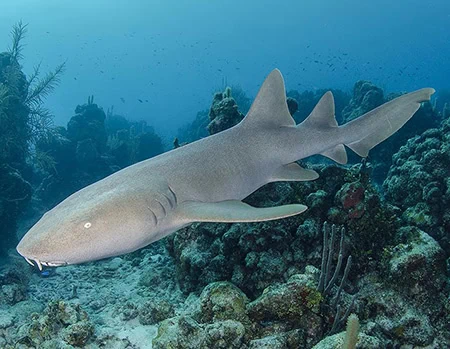
(Ginglymostoma cirratum)
Nurse Shark
Акула-нянька атлантична
It is found in the eastern Atlantic Ocean, from Cape Verde to Gabon; in the western Atlantic, including the Caribbean Sea, from Rhode Island to southern Brazil; and in the eastern Pacific Ocean from Baja California to Peru. It occurs at depths of 0–150 m.
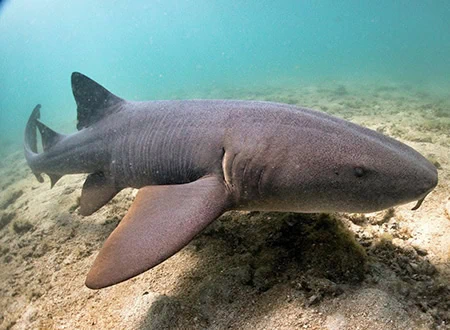
(Ginglymostoma unami)
Pacific Nurse Shark
Акула-нянька тихоокеанська
It is endemic to the Tropical Eastern Pacific, from the Southern coast of Baja California, Mexico and the Gulf of California to Peru. It lives in shallow waters, with sandy and rocky bottoms, and can often be found near rocky or coral reefs, and mangrove forests.
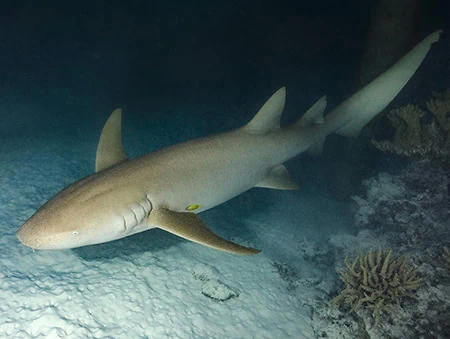
(Nebrius ferrugineus)
Tawny Nurse Shark
Акула-нянька руда
In the Indian Ocean, it it is found from KwaZulu-Natal, South Africa northward to the Red Sea, Persian Gulf and India, including Madagascar, Mauritius, the Chagos Archipelago, the Seychelles, and the Maldives. In the western Pacific, it occurs from southern Japan and the coast of China to the Philippines, Southeast Asia, and Indonesia, to as far south as the northern coast of Australia. In the central Pacific, it has been reported from off New Caledonia, Samoa, Palau, the Marshall Islands, and Tahiti.
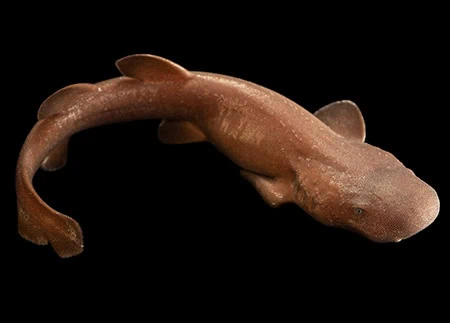
(Pseudoginglymostoma brevicaudatum)
Short-tail Nurse Shark
Акула-нянька короткохвоста
It has been documented in the west Indian Ocean off of Tanzania, Kenya, Madagascar and in Mozambique.
