


(Potoroidae)
Potoroos and Bettongs
Поторові
The potoroids are smaller relatives of the kangaroos and wallabies, and may be ancestral to that group. In particular, the teeth show a simpler pattern than in the kangaroo family, with longer upper incisors, larger canines, and four cusps on the molars. However, both groups possess a wide diastema between the incisors and the cheek teeth.
The potoroids are smaller relatives of the kangaroos and wallabies, and may be ancestral to that group. In particular, the teeth show a simpler pattern than in the kangaroo family, with longer upper incisors, larger canines, and four cusps on the molars. However, both groups possess a wide diastema between the incisors and the cheek teeth.
In most respects, however, the potoroids are similar to small wallabies. Their hind feet are elongated, and they move by hopping, although the adaptations are not as extreme as they are in true wallabies, and, like rabbits, they often use their fore limbs to move about at slower speeds.
The potoroids are, like nearly all diprotodonts, largely herbivorous. However, while they take a wide variety of plant foods, most have a particular taste for the fruiting bodies of fungi, and often depend on fungi to see them through periods when little else is available to eat in the dry Australian bush. One example of a potoroo that sustains itself on fungi is the long-footed potoroo. This animal’s diet is almost entirely made up of underground fungi. This limits its habitat range as it needs to live in a moist environment, with dense cover to reduce predation from introduced species such as foxes and feral cats.
The once populous species of this family played a role in the engineering of soil, dominating the sub-storey of vegetation, and regarded as crucial to the maintenance of the friable soils that they created by digging for fungi and other subsoil foods.
Four modern species of bettongs are extant and two have become extinct. Bettongs were endangered because settlers took much of their habitat, and the red foxes they introduced to the continent also killed many of them. At one time, several species lived all over Australia. Today, the Tasmanian bettong lives only in the eastern half of Tasmania, and the northern bettong lives only in three isolated populations in northern Queensland.
The potoroines have exemplified the impact of ecological changes since colonisation of Australia. Most species have become extinct within their former distribution range, and are either totally extinct or conserved only by preservation in isolated habitat and re-population programs.
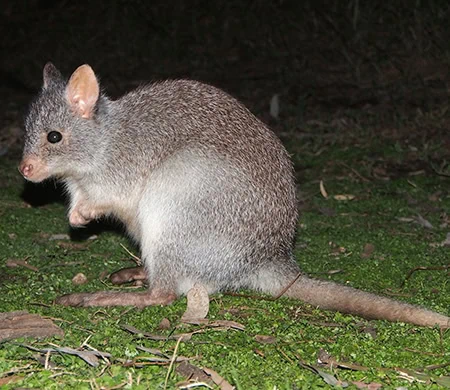
(Aepyprymnus rufescens)
Rufous Bettong
Рудий кенгуровий щур
It is found in coastal and subcoastal regions of eastern Australia, from Newcastle in New South Wales to Cooktown in Queensland. It was formerly also found in the Murray River Valley of New South Wales and Victoria.
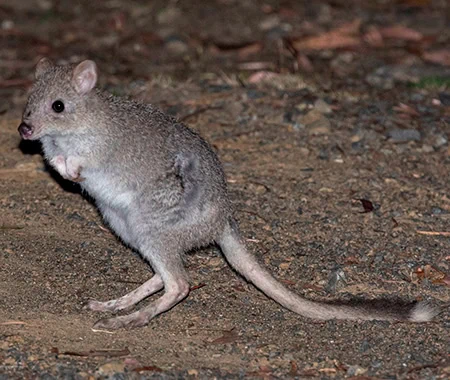
(Bettongia gaimardi)
Eastern Bettong
Східний кенгуровий щур
It is native to grassy forests of southeastern Australia and Tasmania.
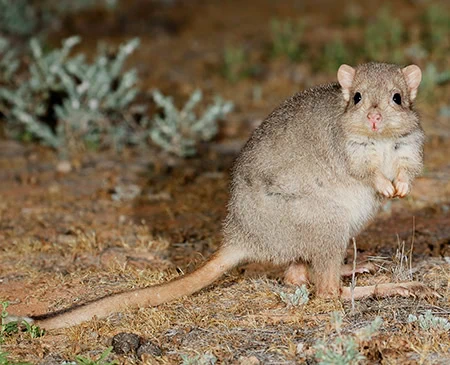
(Bettongia lesueur)
Burrowing Bettong
Кенгуровий щур Лесюера
It is found on three islands off the west coast of Australia—Bernier, Dorre, and Barrow—and has been reintroduced to the mainland since the 2000s.
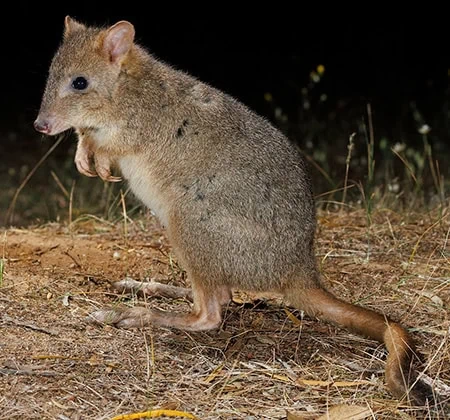
(Bettongia ogilbyi)
Woylie
Войлі
It is native to the forests and shrublands of Australia. It is currently restricted to two small areas in Western Australia.
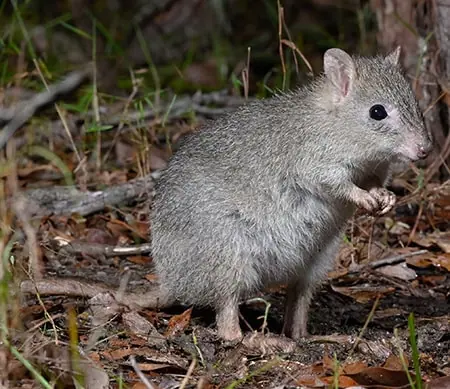
(Bettongia tropica)
Northern Bettong
Північний кенгуровий щур
It is restricted to some areas of mixed open Eucalyptus woodlands and Allocasuarina forests bordering rainforests in far northeastern Queensland, Australia.
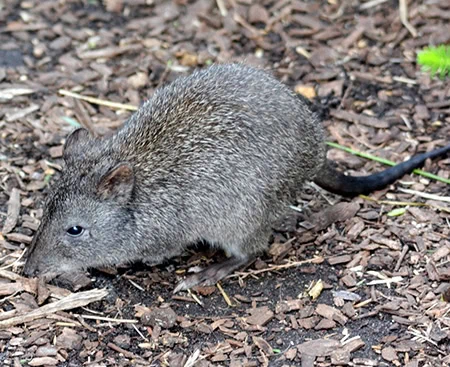
(Potorous gilbertii)
Gilbert's Potoroo
Потору Гілберта
It is found in south-western Western Australia.
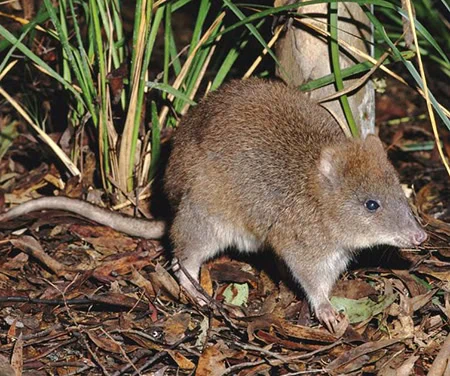
(Potorous longipes)
Long-footed Potoroo
Потору довгоногий
It is found in south-eastern Australia, restricted to an area around the coastal border between New South Wales and Victoria. It lives in a range of montane forests. It has also been found in the warmer temperate rainforest.
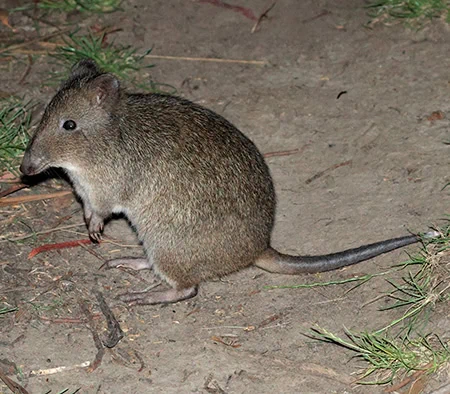
(Potorous tridactylus)
Long-nosed Potoroo
Потору довгоносий
It is native to forests and shrubland of south-eastern Australia and Tasmania.


