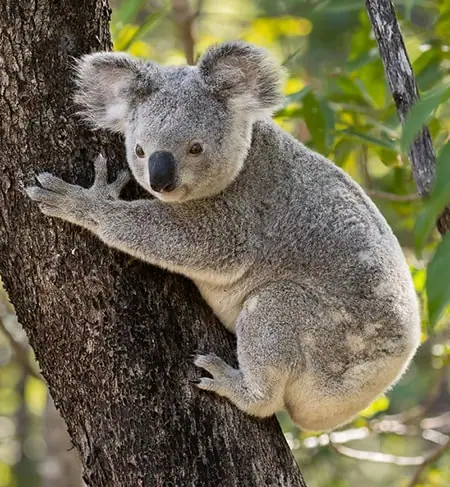

(Phascolarctidae)
Koalas
Коалові
(Phascolarctos cinereus)
Koala
Коала сірий
The koala, sometimes inaccurately called the koala bear, is an arboreal herbivorous marsupial native to Australia. It is the only extant representative of the family Phascolarctidae. Its closest living relatives are the wombats. The koala is found in coastal areas of the continent’s eastern and southern regions, inhabiting Queensland, New South Wales, Victoria, and South Australia. It is easily recognisable by its stout, tailless body and large head with round, fluffy ears and large, dark nose.
Distribution and habitat
The koala’s range covers roughly 1,000,000 km2, and 30 ecoregions. They can be found in both tropical and temperate habitats ranging from dense woodlands to more spaced-out forests. In semi-arid climates, they prefer riparian habitats, where nearby streams and creeks provide refuge during times of drought and extreme heat. It ranges throughout mainland eastern and southeastern Australia, including the states of Queensland, New South Wales, Victoria, and South Australia. The koala was introduced to several nearby islands. The population on Magnetic Island represents the northern limit of its range.
Foraging and activities
Koalas are herbivorous, and while most of their diet consists of eucalypt leaves, they can be found in trees of other genera, such as Acacia, Allocasuarina, Callitris, Leptospermum, and Melaleuca. Though the foliage of over 600 species of Eucalyptus is available, the koala shows a strong preference for around 30. They prefer plant matter with higher protein than fibre and lignin. The most favoured species are Eucalyptus microcorys, E. tereticornis, and E. camaldulensis, which, on average, make up more than 20% of their diet. Despite its reputation as a picky eater, the koala is more generalist than some other marsupial species, such as the greater glider. The koala does not need to drink often as it can get enough water from the leaves, though larger males may additionally drink water found on the ground or in tree hollows. When feeding, a koala reaches out to grab leaves with one forepaw while the other paws hang on to the branch. Depending on the size of the individual, a koala can walk to the end of a branch or must stay near the base. Each day, koalas eat up to 400 g of leaves, spread over four to six feeding periods. Despite their adaptations to a low-energy lifestyle, they have meagre fat reserves.
Their low-energy diet limits their activity and they sleep 20 hours a day. They are predominantly active at night and spend most of their waking hours foraging. They typically eat and sleep in the same tree, possibly for as long as a day. On warm days, a koala may rest with its back against a branch or lie down with its limbs dangling. When it gets hot, the koala rests lower in the canopy and near the trunk, where the surface is cooler than the surrounding air. It curls up when it gets cold and wet. It resorts to a lower, thicker, branch during high winds. While it spends most of the time in the tree, the animal descends to the ground to move to another tree, with either a walking or leaping gait. Research has shown that their use of the ground is minimal, typically occurring only 2–3 times per night for a total of around 10 minutes — less than 1% of their day. The koala usually grooms itself with its hind paws, with their double claws, but it sometimes uses its forepaws or mouth.
Social life
Koalas are asocial and spend just 15 minutes a day on social behaviours. In areas of higher density and fewer trees, home ranges are smaller and more clumped. Koala society appears to consist of “residents” and “transients”: the former are mostly adult females and the latter are males. Resident males appear to be territorial and dominant. The territories of dominant males are found near breeding females, while younger males must wait until they reach full size to challenge for breeding rights. Adult males occasionally venture outside their home ranges; when they do, dominant ones retain their status. As a male climbs a new tree, he rubs his chest against it and sometimes dribbles urine. This scent-marking behaviour probably serves as communication, and individuals are known to sniff the bottom of a newly found tree. Chest gland secretions are complex chemical mixtures—about 40 compounds were identified in one analysis—that vary in composition and concentration across season and age.
Adult males communicate with loud bellows—”a long series of deep, snoring inhalations and belching exhalations”. Because of their low frequency, these bellows can travel far through the forest. Koalas may bellow at any time, particularly during the breeding season, when it serves to attract females and possibly intimidate other males. They also bellow to advertise their presence when they change trees. These sounds signal and exaggerate the male’s body size; females pay more attention to bellows by larger males. Female koalas bellow, though more softly, in addition to making snarls, wails, and screams. These calls are produced when in distress and when making defensive threats. Younger animals squeak and older ones squawk when distraught. When another individual climbs over it, a koala makes a low closed-mouth grunt. Koalas also communicate with facial expressions. When snarling, wailing, or squawking, the animal curls the upper lip and points its ears forward. Screaming koalas pull their lips and ears back. Females form an oval shape with their lips when annoyed.
Agonistic behaviour typically consists of quarrels between individuals who are trying to pass each other on a tree. This occasionally involves biting. Strangers may wrestle, chase, and bite. In extreme situations, a larger male may try to displace a smaller rival from a tree, chasing, cornering, and biting it. Once the individual is driven away, the victor bellows and marks the tree. Pregnant and lactating females are particularly aggressive and attack individuals who come too close. In general, however, koalas tend to avoid fighting due to energy costs.
Reproduction and development
Koalas are seasonal breeders, and they give birth from October to May. Females in oestrus lean their heads back and shake their bodies. Despite these obvious signals, males try to copulate with any female during this period, mounting them from behind. Because of his much larger size, a male can overpower a female. A female may scream and vigorously fight off her suitors but will accede to one that is dominant or familiar. The commotion can attract other males to the scene, obliging the incumbent to delay mating and fight off the intruders. A female may learn who is more dominant during these fights. Older males typically accumulate scratches, scars, and cuts on the exposed parts of their noses and their eyelids.
Koalas are induced ovulators. The gestation period lasts 33–35 days, and a female gives birth to one joey or occasionally, twins. The young are born tiny and barely formed, weighing no more than 0.5 g. However, their lips, forelimbs, and shoulders are relatively advanced, and they can breathe, defecate, and urinate. The joey crawls into its mother’s pouch to continue its development. Female koalas do not clean their pouches, which is an unusual trait among marsupials.
The joey latches on to one of the female’s two teats and suckles it. The female lactates for as long as a year to make up for her low energy production. Unlike in other marsupials, koala milk becomes less fatty as the joey grows. After seven weeks, the joey has a proportionally large head, clear edges around its face, more colouration, and a visible pouch (if female) or scrotum (male). At 13 weeks, the joey weighs around 50 g, and its head doubles in size. The eyes begin to open and hair begins to appear. At 26 weeks, the fully furred animal resembles an adult and can look outside the pouch.
At six or seven months, the joey weighs 300–500 g and fully emerges from the pouch for the first time. It explores its new surroundings cautiously, clutching its mother for support. Around this time, the mother prepares it for a eucalyptus diet by producing a faecal pap that the joey eats from her cloaca. This pap comes from the cecum, is more liquid than regular faeces, and is filled with bacteria. A nine month old joey has its adult coat colour and weighs 1 kg. Having permanently left the pouch, it rides on its mother’s back for transportation, learning to climb by grasping branches. Gradually, it becomes more independent. The mother becomes pregnant again after a year after the offspring reaches around 2.5 kg. She permanently severs her bond with her previous offspring and no longer allows it to suckle, but it remains nearby until it is one-and-a-half to two years old.
Females become sexually mature at about three years of age; in comparison, males reach sexual maturity at about age four although they can experience spermatogenesis as early as two years. Males do not start marking their scent until they reach sexual maturity though their chest glands become functional much earlier. Koalas can breed every year if environmental conditions are good, though the long dependence of the young usually leads to year-long gaps in births.