

(Mitsukurinidae)
Goblin Sharks
Скапаноринхові акули
(Mitsukurina owstoni)
Goblin Shark
Акула-домовик
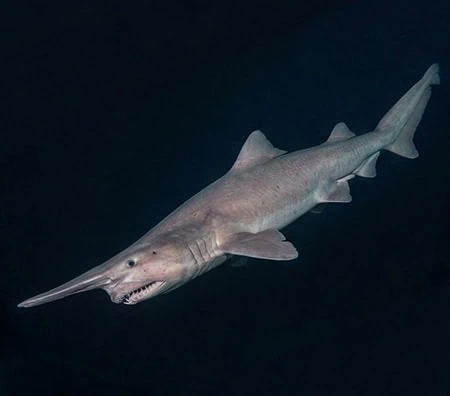
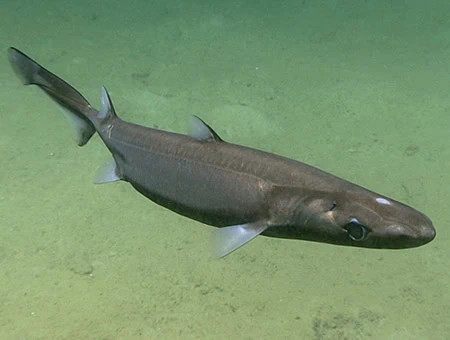
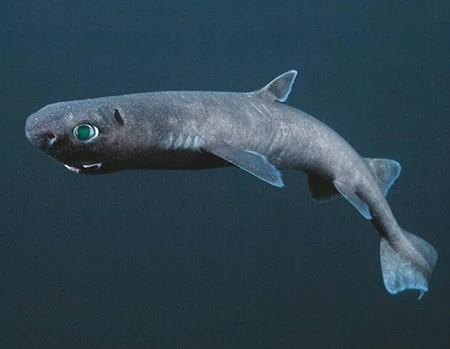
It is a rare species of deep-sea shark. Sometimes called a “living fossil”, it is the only extant representative of the family Mitsukurinidae, a lineage some 125 million years old. This pink-skinned animal has a distinctive profile with an elongated, flat snout, and highly protrusible jaws containing prominent nail-like teeth. It typically reaches a length of 3 to 4 m when fully grown, although it can grow significantly larger—such as one specimen captured in 2000, which was believed to measure around 6 m. Goblin sharks are benthopelagic creatures that inhabit upper continental slopes, submarine canyons, and seamounts throughout the world at depths greater than 100 m, with adults found deeper than juveniles. Some researchers believed that these sharks could also dive to depths of up to 1,300 m, for short periods; footage captured in 2024 suggests that their range could be deeper than previously thought, with a confirmed sighting of an adult swimming at 2,000 m.
As a deep-sea species, the goblin shark poses no danger to humans.
Distribution and habitat
The goblin shark has been caught in all three major oceans, indicating a wide global distribution. In the Atlantic Ocean, it has been recorded from the northern Gulf of Mexico, Suriname, French Guiana, and southern Brazil in the west, and France, Portugal, Madeira, and Senegal in the east. It has also been collected from seamounts along the Mid-Atlantic Ridge. In the Indo-Pacific and Oceania, it has been found off of the coasts of South Africa, Mozambique, Japan, Taiwan, Australia and New Zealand. This species has been recorded from off East Cape to Kaikōura Canyon and from the Challenger Plateau near New Zealand. A single eastern Pacific specimen is known, collected off southern California.
This species is most often found over the upper continental slope at depths of 270–960 m. It has been caught as deep as 1,300 m, a tooth has been found lodged in an undersea cable at a depth of 1,370 m. It has been sighted as deep as 2,000 m. Adults inhabit greater depths than juveniles. Immature goblin sharks frequent the submarine canyons off southern Japan at depths of 100–350 m, with individuals occasionally wandering into inshore waters as shallow as 40 m.
Biology and ecology
Although observations of living goblin sharks are scant, its anatomy suggests an inactive and sluggish lifestyle. Its skeleton is reduced and poorly calcified, the muscle blocks along its sides (myomeres) are weakly developed, and its fins are soft and small. Its long caudal fin, held at a low angle, is also typical of a slow-swimming shark. The long snout appears to have a sensory function, as it bears numerous ampullae of Lorenzini that detect weak electric fields produced by other animals. Due to the snout’s softness, it is unlikely to be used for stirring up prey from the bottom as has been proposed. Vision seems to be less important than other senses, considering the relatively small optic tectum in the shark’s brain. Yet unlike most deep-sea sharks, it can change the size of its pupils, thus probably does use sight in some situations. Goblin sharks may be the prey of blue sharks (Prionace glauca). Parasites documented from this species include the copepod Echthrogaleus mitsukurinae, and the tapeworms Litobothrium amsichensis and Marsupiobothrium gobelinus.
Feeding
The goblin shark feeds mainly on deep-sea teleost fishes such as rattails and dragonfishes. It also eats cephalopods and crustaceans, including decapods and isopods. Garbage has been recorded from the stomachs of some specimens. Its known prey includes bottom-dwelling species such as the blackbelly rosefish (Helicolenus dactylopterus), and midwater species such as the squid Teuthowenia pellucida and the ostracod Macrocypridina castanea rotunda. Thus, the goblin shark appears to forage for food both near the sea floor and far above it.
Since it is not a fast swimmer, the goblin shark may be an ambush predator. Its low-density flesh and large oily liver make it neutrally buoyant, allowing it to drift towards its prey with minimal motions so as to avoid detection. Once prey comes into range, the shark’s specialized jaws can snap forward to capture it. The protrusion of the jaw is assisted by two pairs of elastic ligaments associated with the mandibular joint, which are pulled taut when the jaws are in their normal retracted position. Upon biting, the ligaments release their tension and “catapult” the jaws forward. At the same time, the well-developed basihyal (analogous to a tongue) on the floor of the mouth drops, expanding the oral cavity and sucking in water and prey. Goblin sharks use ram feeding, a type of prey capture typical of many mackerel sharks. The video evidence suggests that what makes the goblin shark unique is the kinematics of their jaw when feeding. The lower jaw seems to undergo more complex movements and is important in capturing the prey. The measured protrusions of the upper and lower jaw combined put the goblin shark jaws at 2.1–9.5 times more protrusible than other sharks. The lower jaw has a velocity about two times greater than the upper jaw because it not only protrudes forward, but also swings upward to capture the prey, and the maximum velocity of the jaws is 3.14 m/s. The goblin shark has a re-opening and re-closing pattern during the strike, a behavior never observed in other sharks, and which could be related to the extent with which the goblin shark protrudes its jaws.
Growth and reproduction
The reproductive behaviors of the goblin shark are poorly understood and mating has never been observed. Fishermen in Taiwan captured a pregnant female carrying six pups in 2023. It likely shares the reproductive characteristics of other mackerel sharks, which are viviparous with small litter sizes and embryos that grow during gestation by eating undeveloped eggs (oophagy). The birth size is probably close to 82 cm, the length of the smallest known specimen. Males mature sexually at about 2.6 m long, while female maturation size is unknown. No data is available concerning growth and aging. Some researchers have estimated, based on their own research and prior findings, that male goblin sharks mature at approximately 16 years old and can live up to 60 years.