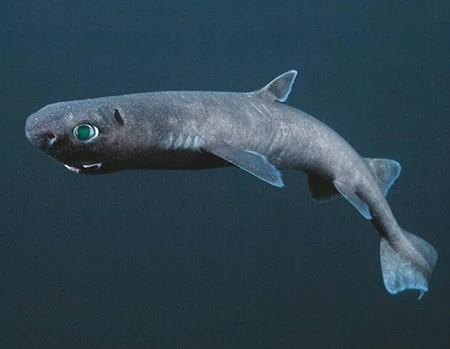


(Odontaspididae)
Sand Sharks
Піщані акули
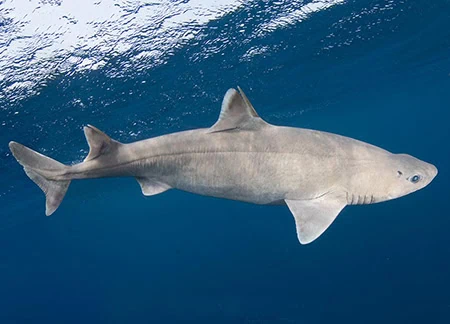
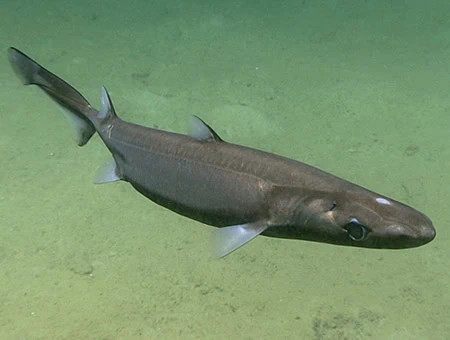
Sand sharks are mackerel sharks of the family Odontaspididae. They are found worldwide in temperate and tropical waters. The family contains two species in a single extant genus (Odontaspis), as well as several extinct genera. The genus Carcharias was formerly included in the family.
The body tends to be brown with dark markings in the upper half. These markings disappear as they mature. Their needle-like teeth are highly adapted for impaling fish, their main prey. Their teeth are long, narrow, and very sharp with smooth edges, with one and on occasion two smaller cusplets on either side. Sand sharks have a large second dorsal fin.
Location and origins
The name sand shark comes from their tendency to migrate toward shoreline habitats, and they are often seen swimming around the ocean floor in the surf zone; at times, they come very close to shore. They are often found in warm or temperate waters throughout the world’s oceans, except the eastern Pacific. They also frequent the Mediterranean and Adriatic Seas at depths from 20 to 200 m and sometimes more.
Behavior
The sand shark has a unique hunting strategy. It is able to gulp air from above the surface and collect the air in its stomach. This enables it to become buoyant and approach its prey virtually motionless. During the day, the sand shark stays mostly inactive, but at night, it becomes active and resumes hunting activities. Its staple is small fish, but it eats crustaceans and squid, as well. It occasionally hunts in shivers (groups), and has even been known to attack full fishing nets.
Reproduction
Sand sharks only develop two embryos, one in each uterus. The largest and strongest embryos consume their siblings in the womb (intrauterine cannibalism) before each surviving pup is born. It has one of the lowest reproduction rates of all sharks and is susceptible to even minimal population pressure, so it is listed as vulnerable and is protected in much of its range.
Attacks on people
Sand sharks are not known to attack humans. If a person were to provoke a sand shark, it may retaliate defensively. Sand sharks are generally not aggressive, but harass divers who are spearfishing. In North America, wreck divers regularly visit the World War II shipwrecks to dive with the sharks that make the wrecks their home.
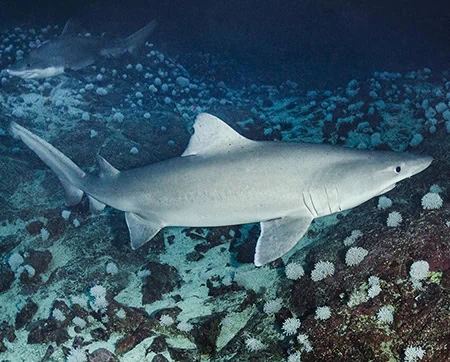
(Odontaspis ferox)
Smalltooth Sand Tiger
Піщана акула дрібнозуба
It is found in tropical and warm-temperate waters of the Bay of Biscay and the Adriatic Sea, as well as off North Carolina (United States), the Yucatán Peninsula and Baja California Peninsula (Mexico), southern Brazil, Colombia, Syria, Lebanon, Algeria, Tunisia, Morocco, Western Sahara, South Africa, Madagascar, Tanzania, north-eastern Australia, New Zealand, New Caledonia, Hawaii, southern Japan, southern India, Sri Lanka, and the Maldives. It occurs at depths of 10–800 m.
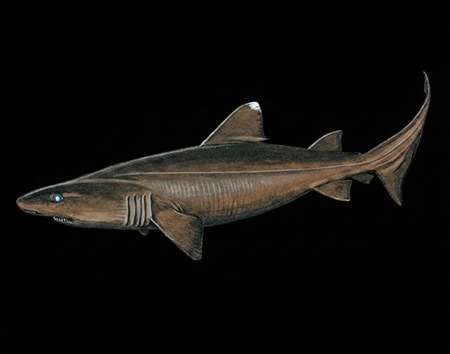
(Odontaspis noronhai)
Bigeye Sand Tiger
Піщана акула великоока
It is found in tropical and warm-temperate oceanic waters off the coasts of Portugal, Mexico, and Brazil, along the Mid-Atlantic Ridge, and in the waters of the Seychelles, Hawaii, Marshall Islands, and the South China Sea. It occurs at depths of 60–1,000 m.