

(Megachasmidae)
Megamouth Sharks
Великороті акули
(Megachasma pelagios)
Megamouth Shark
Акула великорота
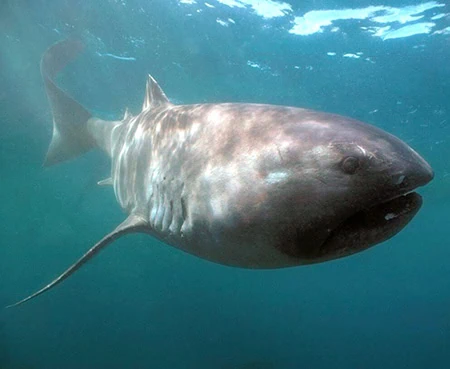
The megamouth shark (Megachasma pelagios) is a species of deepwater shark. Rarely seen by humans, it measures around 4–5.5 long and is the smallest of the three extant filter-feeding sharks alongside the much larger whale shark and basking shark. Like the other two planktivorous sharks, it swims with its mouth wide open, filtering water for plankton and jellyfish. The diet of megamouth sharks mainly consists of zooplanktonic organisms like krill, jellyfish, shrimp larvae, squat lobsters, and crab larvae. It is recognizable from its large head with rubbery lips. The megamouth is so unlike any other type of shark that it is usually considered to be the sole extant species in the family Megachasmidae, though some scientists have suggested it may belong in the family Cetorhinidae.
As of March 25, 2025 only 296 megamouth specimens had been caught or sighted. They have been found in the Pacific, Atlantic, and Indian Oceans. Japan, the Philippines, and Taiwan have each yielded at least 10 specimens, the most of any single area, amounting to more than half the worldwide total. Specimens have also been sighted in or come out of the waters near Hawaii, California, Mexico, Indonesia, Australia, Brazil, Senegal, South Africa, Puerto Rico, Ecuador, and possibly Vietnam.
Description
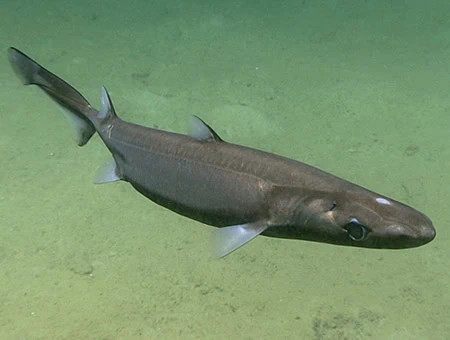
The appearance of the megamouth is distinctive, but little else is known about it. It has a brownish-black colour on top, is white underneath, and has an asymmetrical tail with a long upper lobe, similar to that of the thresher shark. The interior of its gill slits are lined with finger-like gill rakers that capture its food. A relatively poor swimmer, the megamouth has a soft, flabby body and lacks caudal keels. The megamouth is considerably less active than the other filter-feeding sharks. The megamouth has a stout body and a long, wide bulbous head.
The appearance of the megamouth is distinctive, but little else is known about it. Megamouth sharks are dark blue, brownish-black, or gray above, lighter below; with a white band along the upper jaw; while the posterior margin of its fins are white, and has an asymmetrical tail with a long upper lobe, similar to that of the thresher shark. The interior of its gill slits are lined with finger-like gill rakers that capture its food. A relatively poor swimmer, the megamouth has a soft, flabby body and lacks caudal keels. The megamouth is considerably less active than the other filter-feeding sharks. The megamouth has a stout body and a long, wide bulbous head.
As their name implies, megamouths have a large mouth with small teeth, and a broad, rounded snout, causing observers occasionally to mistake the megamouth for a young orca. The protruding inside of the upper lip is a brilliant silvery-white, which is very visible when the mouth is open. This lip was initially thought to potentially be embedded by luminous photophores when the first shark was examined in the early 1980s, which may act as a lure for plankton. A later team of researchers examining the second captured specimen in the mid-1980s instead proposed that the lower lip might reflect light to produce a glow, but neither theory has been proven. In 2020, a study concluded that megamouths do not in fact produce any light; the white band was found to merely be highly reflective of light. This white band is present in both sexes and could be either a feeding mechanism or possibly be used as a means of identifying other individuals of megamouth sharks. Study of a single specimen revealed electrosensory pores concentrated on the shark’s head. While this specimen had less ampullary pores than any other known species of shark, the pores may still allow for electrosensory detection of prey to enhance feeding efficiency. Their mouths can reach up to 1.3 m in width. Megamouth sharks have up to 50 rows of teeth in their upper-jaw and up to 75 rows of teeth in their lower-jaw. The teeth of the megamouth shark are small and peg-like.
Behaviour
In 1990, a 4.9-m male megamouth shark was caught near the surface off Dana Point, California. This individual was eventually released with a small radio tag attached to its soft body. The tag relayed depth and time information over a two-day period. During the day, the shark swam at a depth around 120–160 m, but as the sun set, it would ascend and spend the night at depths between 12 and 25 m. Both day and night, its progress was very slow, around 1.5–2.1 km/h. In a 2024 study, three sharks were tagged off the coast of Taiwan and tracked over a multi-month period. The sharks reached a maximum depth from about 400–700 m during the day, on average. At night, they typically reached their minimum depth of 0–50 m. This pattern of vertical migration is seen in many marine animals as they track the movement of plankton in the water column.
Megamouth sharks undergo some seasonal migration as well, though this may be less consistent between individuals. While one shark migrated north from Taiwan during the summer, another migrated south. In one instance, two megamouth sharks were observed together by fishermen off the coast of California. This revealed previously unknown social behaviors between individuals. Potential explanations for the behavior include foraging or mating, though neither behavior was specifically observed.
Reproduction
Reproduction is ovoviviparous, meaning that the young sharks develop in eggs that remain within the mother’s body until they hatch. Tissue samples were obtained from twenty-seven megamouths caught in a two-year period off the Hualien coast (eastern Taiwan), and two caught in Baja California, Mexico, and samples taken from GenBank to perform a population genetic analyses of the megamouth shark; the results indicated no genetic diversity between populations found in different geographical locations, which indicates the species forms a single, highly migratory, interbreeding population. Fishermen encountered and recorded two megamouth sharks on September 11, 2022— the first instance multiple members of the species were caught on camera at once. In the footage, the male shark closely followed the female shark, trailing underneath her. While unclear, it’s possible that the footage documented potential courtship behavior of the megamouth shark as trailing is associated with pre-copulatory behavior in other closely related shark species.